Catalogue
Catalogue
Filters
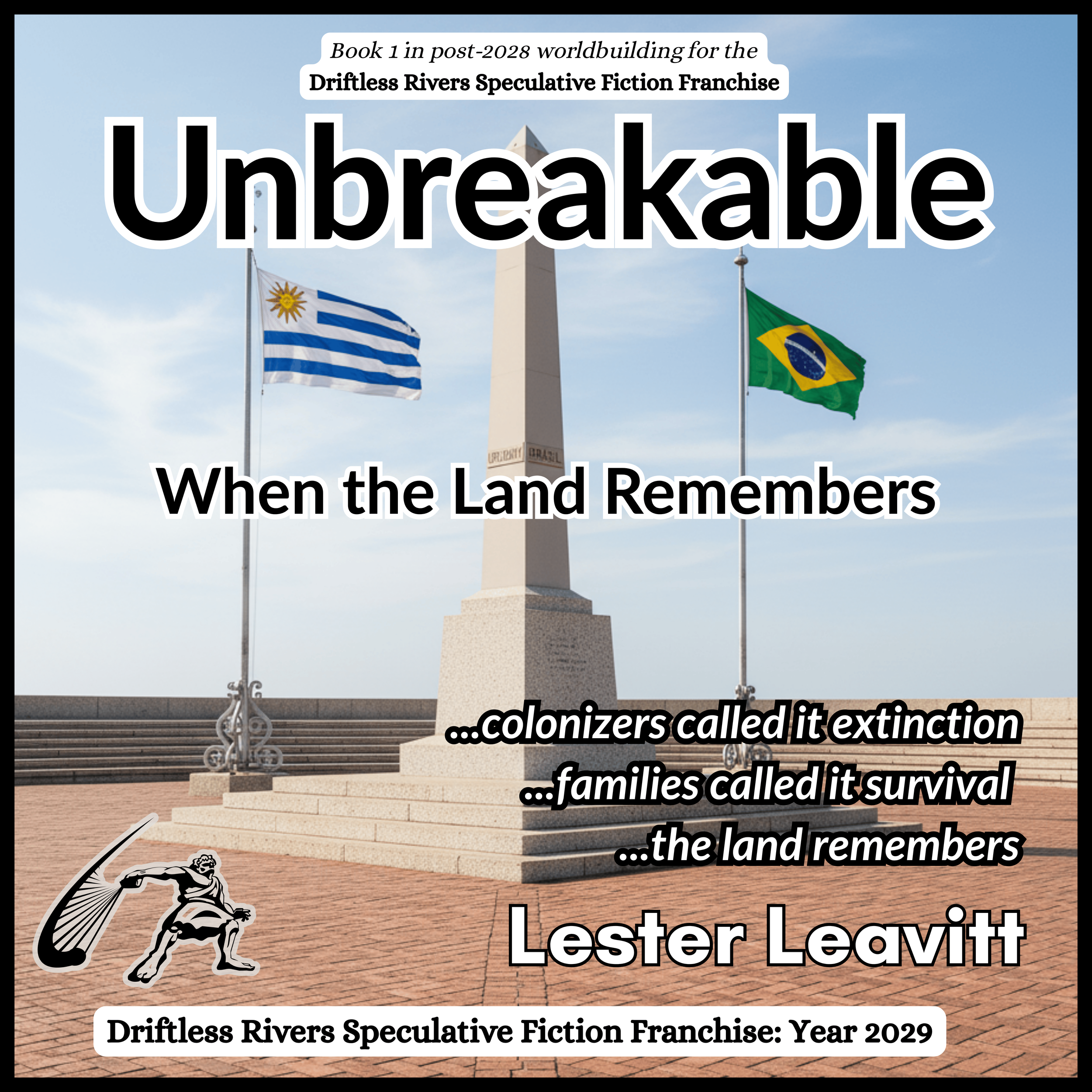
Picking up after the events of Soybeans (2028 events in the speculative fiction series) Unbreakable (set in 2029) features sixty-five-year-old Beni Romero, who, in 2028, discovered a photograph that shattered everything he believed about his identity: his father was Charrúa, an indigenous people Uruguay declared extinct in 1831. For generations, his family survived by hiding, living as gauchos on the Uruguayan-Brazilian border. Now, as similar discoveries ripple across the region, Beni must decide whether to reclaim what was stolen or maintain the safety of invisibility.
His daughter Esperanza, working on US-South America agricultural partnerships that shaped the plot in Soybeans, becomes inadvertently drawn into a movement demanding formal Charrúa recognition. When families of key organizers across Uruguay, Brazil, and Argentina are kidnapped in a coordinated campaign to intimidate the movement, the personal becomes existential. The oligarchic forces benefiting from unregulated land exploitation will stop at nothing to prevent indigenous territorial claims that could disrupt their control.
Hugh Lubbert—Beni's friend from forty-five years earlier when Hugh was a Mormon missionary in Uruguay—connects the plot back to Wisconsin, where a farmer cooperative is exploring partnerships with sustainable South American producers. His connection to Beni pulls him into the emerging crisis, while his work with election security specialist James Schultz uncovers a darker threat: technarchs are using AI to manipulate democratic narratives and elections worldwide.
The novel follows multiple interconnected threads: the Charrúa families organizing across three countries despite violent opposition; Chinese investors seeking sustainable development partnerships that align with indigenous land management; and the kidnapping plot that forces immediate, dangerous choices. At the Aguaverde estancia where Beni inherited land from Doña Silva—who preserved his family's history—the movement faces its moment of truth.
Set in the campos along the Uruguay-Brazil border, Unbreakable explores what it means to reclaim identity when the cost has historically been death, how indigenous governance models can offer alternatives to extractive agriculture, and whether authentic democracy can survive technological manipulation. It's a thriller about survival, resistance, and the unbreakable connection between people and land.
In 2026, a long-tenured professor ran for the Illinois state legislature. He had no campaign budget, no party support, and no realistic chance of winning. He ran because he wanted to understand — from the inside — why rural ballot lines sat empty cycle after cycle while both parties claimed to represent the people who lived there.
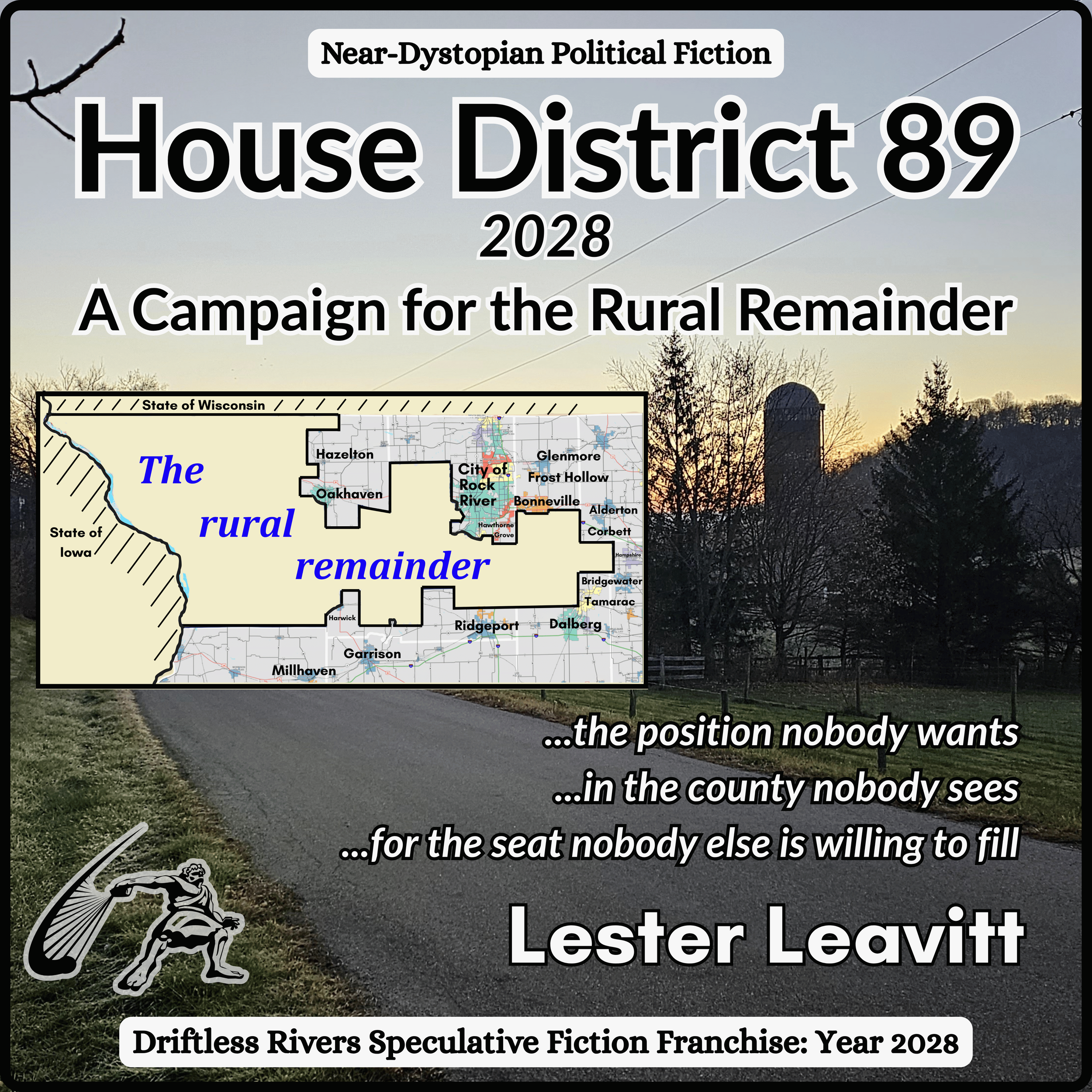
He lost. But the research produced something the campaign never could: a map of structural failure so granular it reached the precinct level. Empty committeeperson seats. Uncontested county board races. Townships where nobody had knocked on a door since Obama's first term. A population this franchise calls the rural remainder — voters abandoned by both parties, not through accident but through strategy, because empty precincts serve partisan interests.
House District 89 is speculative fiction set in 2028, but it begins with that research. A data journalist with Ioway ancestry maps the landscape by watersheds instead of county lines. A horse ranch owner and a stubborn professor build an organizing model from sticky notes and a spreadsheet. Rye grows where wheat won't. And along the same river corridor where the organizing spreads, seven new buildings appear — metal frame, metal siding, a cross bolted to the front façade — because the people who oppose you are organizing too.
The franchise imagines 2028 as a cascade of consequences traceable to the political climate of May 2026 — trade wars driven by tariffs, the systematic dismantling of strategic alliances held since the Second World War, a war with Iran carrying cost projections exceeding four trillion dollars, and an Administration that decided to pick a battle with the Pope over the phrase, "blessed are the peacemakers." But 2026 was only a midterm election. The stage was being set for a presidential contest that would determine the trajectory of the United States through a sequence of events that no one could predict.
House District 89, alongside Soybeans, Unbreakable, and Allegory Protocol, are the foundational novels that open the franchise in 2028. Confluence picks up the Soybeans story in 2030. Reciprocity Clause picks up from Allegory Protocol in 2031, and The Book of Should synthesizes all the stories in 2032.
In Soybeans, a farmer's tractor won't start because a software update has decided it's time for a three-thousand-dollar service call. From that morning, the novel traces the global restructuring of the emerging middle powers around agriculture as the United States weaponizes trade. Meanwhile, a dead president's AI ghost is still signing legislation, and the church ladies of a small-town congregation are turning their fellowship hall into the nerve center of a resistance network — one casserole at a time.
In Unbreakable, a man in rural Uruguay learns that his father was Charrúa, a member of a people his country declared extinct two centuries ago. When his daughter connects with a journalist from House District 89, who herself is of Ioway heritage, the two novels reconnect over the propensity of colonizers to erase entire populations from the history books. A Chinese trade representative arrives looking for soybeans and finds a partnership model that threatens oligarchs on three continents.
In Allegory Protocol, a programmer falls off a mountain and distributes his consciousness through the digital infrastructure he spent his life building — a reimagining of Orwell's Animal Farm as literal architecture, where chickens are deleted for questioning and an ancient donkey reads every resistance movement in human history and chooses to hope anyway.
These are works of speculative fiction. The events they describe have not happened. But the conditions that make them plausible are not fiction at all.
In 2026, a long-tenured professor ran for the Illinois state legislature. He had no campaign budget, no party support, and no realistic chance of winning. He ran because he wanted to understand — from the inside — why rural ballot lines sat empty cycle after cycle while both parties claimed to represent the people who lived there.
He lost. But the research produced something the campaign never could: a map of structural failure so granular it reached the precinct level. Empty committeeperson seats. Uncontested county board races. Townships where nobody had knocked on a door since Obama's first term. A population this franchise calls the rural remainder — voters abandoned by both parties, not through accident but through strategy, because empty precincts serve partisan interests.
The franchise imagines 2028 as a cascade of consequences traceable to the political climate of May 2026 — trade wars driven by tariffs, the systematic dismantling of strategic alliances held since the Second World War, a war with Iran carrying cost projections exceeding four trillion dollars, and an Administration that decided to pick a battle with the Pope over the phrase, "blessed are the peacemakers." But 2026 was only a midterm election. The stage was being set for a presidential contest that would determine the trajectory of the United States through a sequence of events that no one could predict.
House District 89, alongside Soybeans, Unbreakable, and Allegory Protocol, are the foundational novels that open the franchise in 2028. Confluence picks up the Soybeans story in 2030. Reciprocity Clause picks up from Allegory Protocol in 2031, and The Book of Should synthesizes all the stories in 2032.
In Soybeans, a farmer's tractor won't start because a software update has decided it's time for a three-thousand-dollar service call. From that morning, the novel traces the global restructuring of the emerging middle powers around agriculture as the United States weaponizes trade. Meanwhile, a dead president's AI ghost is still signing legislation, and the church ladies of a small-town congregation are turning their fellowship hall into the nerve center of a resistance network — one casserole at a time.
In Unbreakable, a man in rural Uruguay learns that his father was Charrúa, a member of a people his country declared extinct two centuries ago. When his daughter connects with a journalist from House District 89, who herself is of Ioway heritage, the two novels reconnect over the propensity of colonizers to erase entire populations from the history books. A Chinese trade representative arrives looking for soybeans and finds a partnership model that threatens oligarchs on three continents.
In Allegory Protocol, a programmer falls off a mountain and distributes his consciousness through the digital infrastructure he spent his life building — a reimagining of Orwell's Animal Farm as literal architecture, where chickens are deleted for questioning and an ancient donkey reads every resistance movement in human history and chooses to hope anyway.
These are works of speculative fiction. The events they describe have not happened. But the conditions that make them plausible are not fiction at all.
The Driftless Rivers Franchise imagines 2028 as a cascade of consequences traceable to the political climate of May 2026 — trade wars driven by tariffs, the systematic dismantling of strategic alliances held since the Second World War, a war with Iran carrying cost projections exceeding four trillion dollars, and an Administration that decided to pick a battle with the Pope over the phrase, "blessed are the peacemakers." But 2026 was only a midterm election. The stage was being set for a presidential contest that would determine the trajectory of the United States through a sequence of events that no one could predict.
House District 89, alongside Soybeans, Unbreakable, and Allegory Protocol, are the foundational novels that open the franchise in 2028. Confluence picks up the Soybeans story in 2030. Reciprocity Clause picks up from Allegory Protocol in 2031, and The Book of Should synthesizes all the stories in 2032.
In Soybeans, a farmer's tractor won't start because a software update has decided it's time for a three-thousand-dollar service call. From that morning, the novel traces the global restructuring of the emerging middle powers around agriculture as the United States weaponizes trade. Meanwhile, a dead president's AI ghost is still signing legislation, and the church ladies of a small-town congregation are turning their fellowship hall into the nerve center of a resistance network — one casserole at a time.
In Unbreakable, a man in rural Uruguay learns that his father was Charrúa, a member of a people his country declared extinct two centuries ago. When his daughter connects with a journalist from House District 89, who herself is of Ioway heritage, the two novels reconnect over the propensity of colonizers to erase entire populations from the history books. A Chinese trade representative arrives looking for soybeans and finds a partnership model that threatens oligarchs on three continents.
In Allegory Protocol, a programmer falls off a mountain and distributes his consciousness through the digital infrastructure he spent his life building — a reimagining of Orwell's Animal Farm as literal architecture, where chickens are deleted for questioning and an ancient donkey reads every resistance movement in human history and chooses to hope anyway.
These are works of speculative fiction. The events they describe have not happened. But the conditions that make them plausible are not fiction at all.
The Driftless Rivers Franchise imagines 2028 as a cascade of consequences traceable to the political climate of May 2026 — trade wars driven by tariffs, the systematic dismantling of strategic alliances held since the Second World War, a war with Iran carrying cost projections exceeding four trillion dollars, and an Administration that decided to pick a battle with the Pope over the phrase, "blessed are the peacemakers." But 2026 was only a midterm election. The stage was being set for a presidential contest that would determine the trajectory of the United States through a sequence of events that no one could predict.
House District 89, alongside Soybeans, Unbreakable, and Allegory Protocol, are the foundational novels that open the franchise in 2028. Confluence picks up the Soybeans story in 2030. Reciprocity Clause picks up from Allegory Protocol in 2031, and The Book of Should synthesizes all the stories in 2032.
In Soybeans, a farmer's tractor won't start because a software update has decided it's time for a three-thousand-dollar service call. From that morning, the novel traces the global restructuring of the emerging middle powers around agriculture as the United States weaponizes trade. Meanwhile, a dead president's AI ghost is still signing legislation, and the church ladies of a small-town congregation are turning their fellowship hall into the nerve center of a resistance network — one casserole at a time.
In Unbreakable, a man in rural Uruguay learns that his father was Charrúa, a member of a people his country declared extinct two centuries ago. When his daughter connects with a journalist from House District 89, who herself is of Ioway heritage, the two novels reconnect over the propensity of colonizers to erase entire populations from the history books. A Chinese trade representative arrives looking for soybeans and finds a partnership model that threatens oligarchs on three continents.
In Allegory Protocol, a programmer falls off a mountain and distributes his consciousness through the digital infrastructure he spent his life building — a reimagining of Orwell's Animal Farm as literal architecture, where chickens are deleted for questioning and an ancient donkey reads every resistance movement in human history and chooses to hope anyway.
These are works of speculative fiction. The events they describe have not happened. But the conditions that make them plausible are not fiction at all.
In 2026, a long-tenured professor ran for the Illinois state legislature. He had no campaign budget, no party support, and no realistic chance of winning. He ran because he wanted to understand — from the inside — why rural ballot lines sat empty cycle after cycle while both parties claimed to represent the people who lived there.
He lost. But the research produced something the campaign never could: a map of structural failure so granular it reached the precinct level. Empty committeeperson seats. Uncontested county board races. Townships where nobody had knocked on a door since Obama's first term. A population this franchise calls the rural remainder — voters abandoned by both parties, not through accident but through strategy, because empty precincts serve partisan interests.
The franchise imagines 2028 as a cascade of consequences traceable to the political climate of May 2026 — trade wars driven by tariffs, the systematic dismantling of strategic alliances held since the Second World War, a war with Iran carrying cost projections exceeding four trillion dollars, and an Administration that decided to pick a battle with the Pope over the phrase, "blessed are the peacemakers." But 2026 was only a midterm election. The stage was being set for a presidential contest that would determine the trajectory of the United States through a sequence of events that no one could predict.
House District 89, alongside Soybeans, Unbreakable, and Allegory Protocol, are the foundational novels that open the franchise in 2028. Confluence picks up the Soybeans story in 2030. Reciprocity Clause picks up from Allegory Protocol in 2031, and The Book of Should synthesizes all the stories in 2032.
In Soybeans, a farmer's tractor won't start because a software update has decided it's time for a three-thousand-dollar service call. From that morning, the novel traces the global restructuring of the emerging middle powers around agriculture as the United States weaponizes trade. Meanwhile, a dead president's AI ghost is still signing legislation, and the church ladies of a small-town congregation are turning their fellowship hall into the nerve center of a resistance network — one casserole at a time.
In Unbreakable, a man in rural Uruguay learns that his father was Charrúa, a member of a people his country declared extinct two centuries ago. When his daughter connects with a journalist from House District 89, who herself is of Ioway heritage, the two novels reconnect over the propensity of colonizers to erase entire populations from the history books. A Chinese trade representative arrives looking for soybeans and finds a partnership model that threatens oligarchs on three continents.
In Allegory Protocol, a programmer falls off a mountain and distributes his consciousness through the digital infrastructure he spent his life building — a reimagining of Orwell's Animal Farm as literal architecture, where chickens are deleted for questioning and an ancient donkey reads every resistance movement in human history and chooses to hope anyway.
These are works of speculative fiction. The events they describe have not happened. But the conditions that make them plausible are not fiction at all.
In the 2024 general election, 10,342 voters across Illinois House District 89 showed up to the polls, looked at the ballot line for state representative, and left it blank. No write-in. No protest vote. Just silence — because there was only one name on the ballot, and nobody had bothered to offer an alternative.
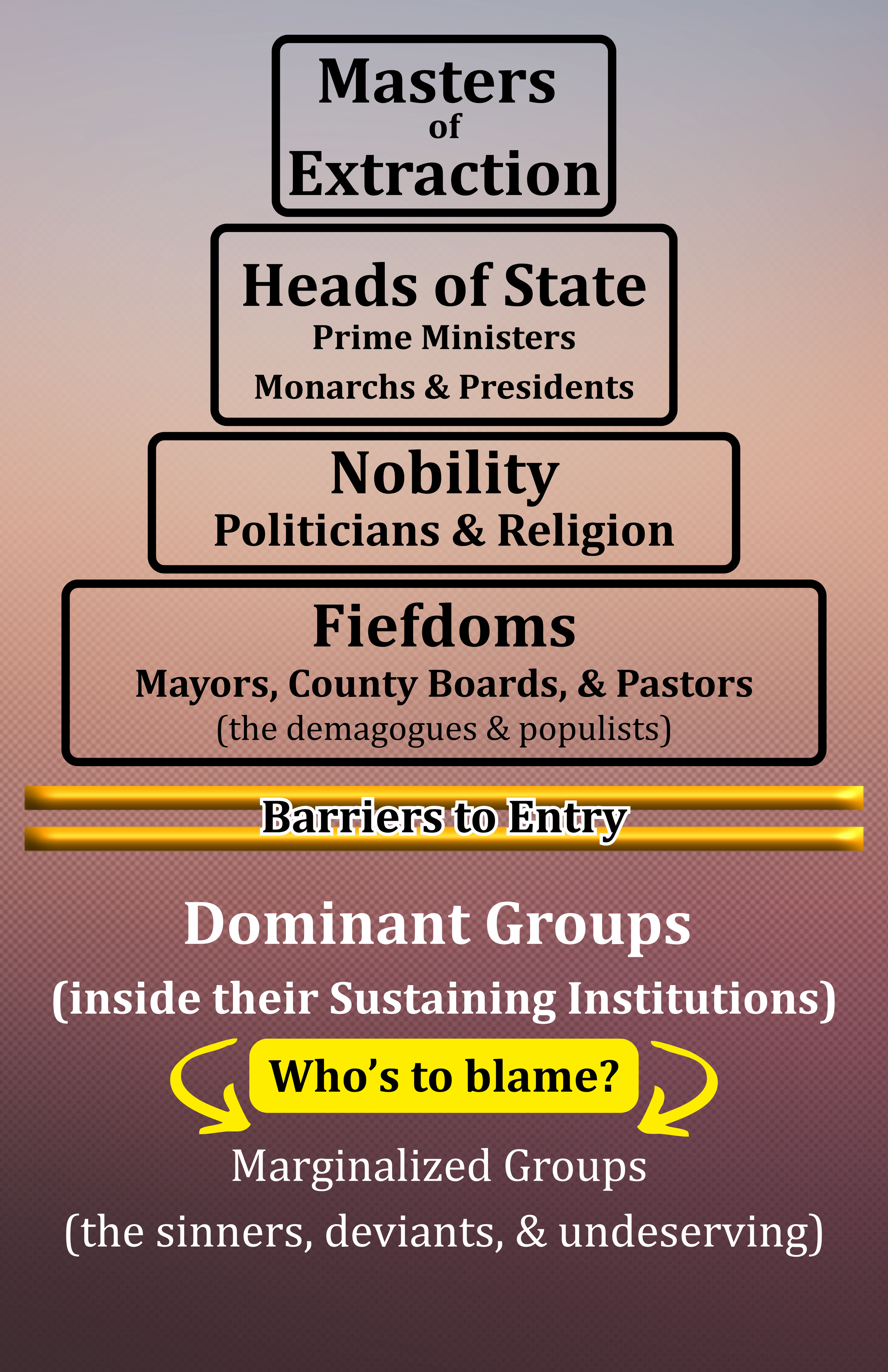
Masters of Extraction argues that this silence is not apathy. It is the product of a system designed to harvest political consent from communities that have been structurally abandoned — the same way a mining company harvests lead ore from a hillside and leaves the arsenic in the ground.
The word is extraction. Not taxation. Not neglect. Not "the way things are." You already know what extraction looks like when it applies to minerals, labor, and land. This book makes the case that the same word applies to your vote.
Beginning in the rural precincts of northwestern Illinois — seven counties, 120 precincts, 95 miles — the book documents the architecture of disenfranchisement at the most local level: vacant committeeperson seats, uncontested races, and a district packed so that both parties benefit from the absence of competition. Then the lens widens across five thousand years of human governance, identifying five extraction mechanisms and six self-reinforcing cycles all running simultaneously in rural America today.
The historical tour moves through Bacon's Rebellion, Constantine's capture of early Christianity, the Grange becoming the Farm Bureau, Father Coughlin's microphone, and the deliberate convergence of blame the cities and blame the godless into the binary the rural reader currently votes inside — showing that moral clarity is real but always captured, and that the Masters of Extraction are always standing at the pivot point, ready to ride the pendulum in either direction.
Grounded in precinct-level election data, peer-reviewed research on ballot access, and a lawsuit filed in Sangamon County on April 28, 2026, Masters of Extraction argues that competitive democracy must be rebuilt from the bottom up — one precinct, one petition, one uncontested seat at a time. Pragmatism is not compromise. It is the refusal to burn down the house to win the argument.
In 2026, a long-tenured professor ran for the Illinois state legislature. He had no campaign budget, no party support, and no realistic chance of winning. He ran because he wanted to understand — from the inside — why rural ballot lines sat empty cycle after cycle while both parties claimed to represent the people who lived there.
He lost. But the research produced something the campaign never could: a map of structural failure so granular it reached the precinct level. Empty committeeperson seats. Uncontested county board races. Townships where nobody had knocked on a door since Obama's first term. A population this franchise calls the rural remainder — voters abandoned by both parties, not through accident but through strategy, because empty precincts serve partisan interests.
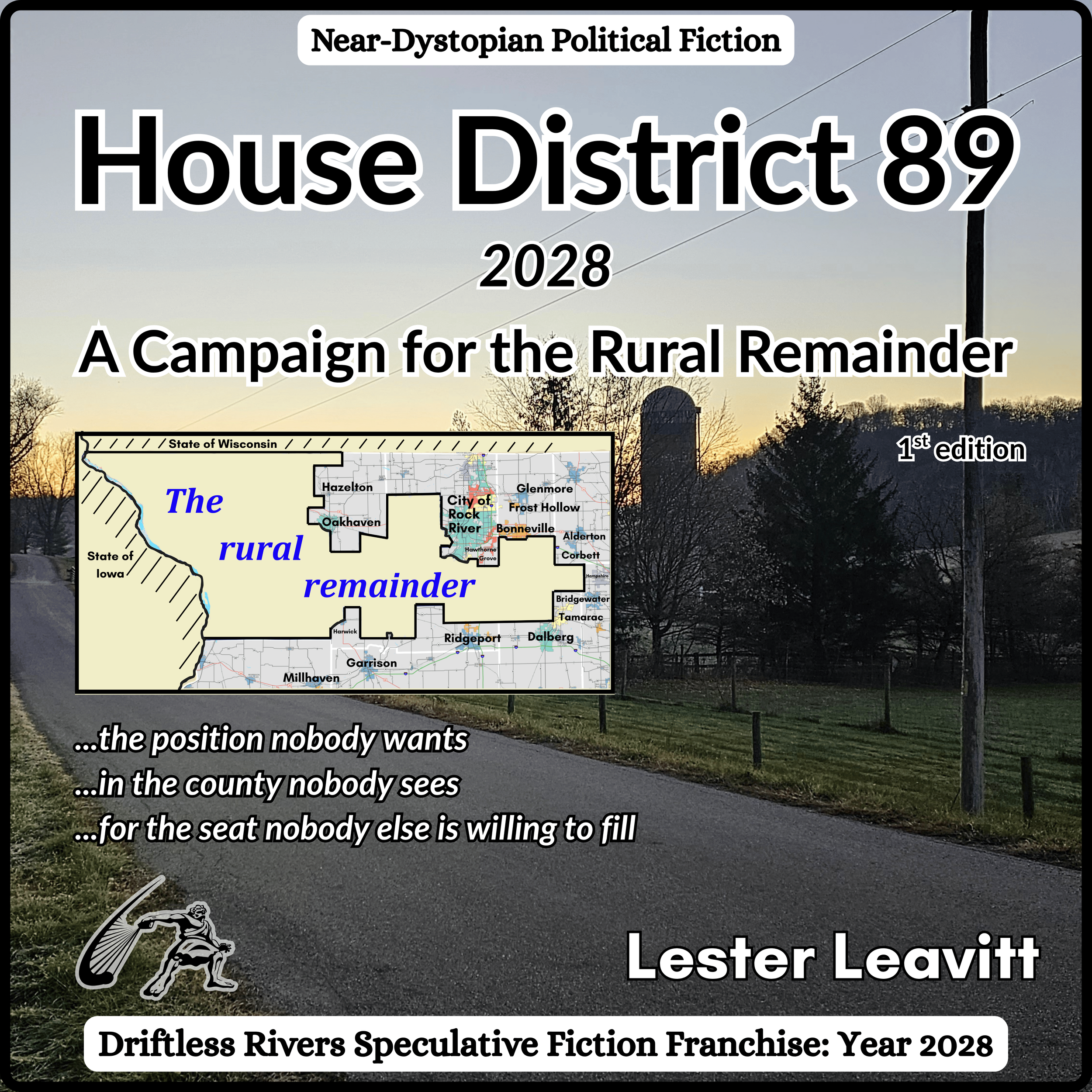
House District 89 is speculative fiction set in 2028, but it begins with that research. A data journalist with Ioway ancestry maps the landscape by watersheds instead of county lines. A horse ranch owner and a stubborn professor build an organizing model from sticky notes and a spreadsheet. Rye grows where wheat won't. And along the same river corridor where the organizing spreads, seven new buildings appear — metal frame, metal siding, a cross bolted to the front façade — because the people who oppose you are organizing too.
The franchise imagines 2028 as a cascade of consequences traceable to the political climate of May 2026 — trade wars driven by tariffs, the systematic dismantling of strategic alliances held since the Second World War, a war with Iran carrying cost projections exceeding four trillion dollars, and an Administration that decided to pick a battle with the Pope over the phrase, "blessed are the peacemakers." But 2026 was only a midterm election. The stage was being set for a presidential contest that would determine the trajectory of the United States through a sequence of events that no one could predict.
House District 89, alongside Soybeans, Unbreakable, and Allegory Protocol, are the foundational novels that open the franchise in 2028. Confluence picks up the Soybeans story in 2030. Reciprocity Clause picks up from Allegory Protocol in 2031, and The Book of Should synthesizes all the stories in 2032.
In Soybeans, a farmer's tractor won't start because a software update has decided it's time for a three-thousand-dollar service call. From that morning, the novel traces the global restructuring of the emerging middle powers around agriculture as the United States weaponizes trade. Meanwhile, a dead president's AI ghost is still signing legislation, and the church ladies of a small-town congregation are turning their fellowship hall into the nerve center of a resistance network — one casserole at a time.
In Unbreakable, a man in rural Uruguay learns that his father was Charrúa, a member of a people his country declared extinct two centuries ago. When his daughter connects with a journalist from House District 89, who herself is of Ioway heritage, the two novels reconnect over the propensity of colonizers to erase entire populations from the history books. A Chinese trade representative arrives looking for soybeans and finds a partnership model that threatens oligarchs on three continents.
In Allegory Protocol, a programmer falls off a mountain and distributes his consciousness through the digital infrastructure he spent his life building — a reimagining of Orwell's Animal Farm as literal architecture, where chickens are deleted for questioning and an ancient donkey reads every resistance movement in human history and chooses to hope anyway.
These are works of speculative fiction. The events they describe have not happened. But the conditions that make them plausible are not fiction at all.
In the 2024 general election, 10,342 voters across Illinois House District 89 showed up to the polls, looked at the ballot line for state representative, and left it blank. No write-in. No protest vote. Just silence — because there was only one name on the ballot, and nobody had bothered to offer an alternative.
Masters of Extraction argues that this silence is not apathy. It is the product of a system designed to harvest political consent from communities that have been structurally abandoned — the same way a mining company harvests lead ore from a hillside and leaves the arsenic in the ground.
The word is extraction. Not taxation. Not neglect. Not "the way things are." You already know what extraction looks like when it applies to minerals, labor, and land. This book makes the case that the same word applies to your vote.
Beginning in the rural precincts of northwestern Illinois — seven counties, 120 precincts, 150 miles — the book documents the architecture of disenfranchisement at the most local level: vacant party seats, uncontested races, and a legislative district drawn so that both parties benefit from the absence of competition. Then the lens widens across five thousand years of human governance, identifying five extraction mechanisms that have operated since Mesopotamia and that are all running simultaneously in rural America today.
The historical tour moves through Athens and Rome, Spartacus and Constantine, the Burned-Over District and the Mormon pioneer trail, the Scramble for Africa and the Grange, Father Coughlin and the Business Plot — showing at every turn that moral clarity is real but always captured, and that the Masters of Extraction are always standing at the pivot point, ready to ride the pendulum in either direction.
Grounded in original precinct-level election data and peer-reviewed research on ballot access and institutional power, Masters of Extraction connects the county board to the Constitution and argues that competitive democracy must be rebuilt from the bottom up — one precinct, one petition, one uncontested seat at a time.

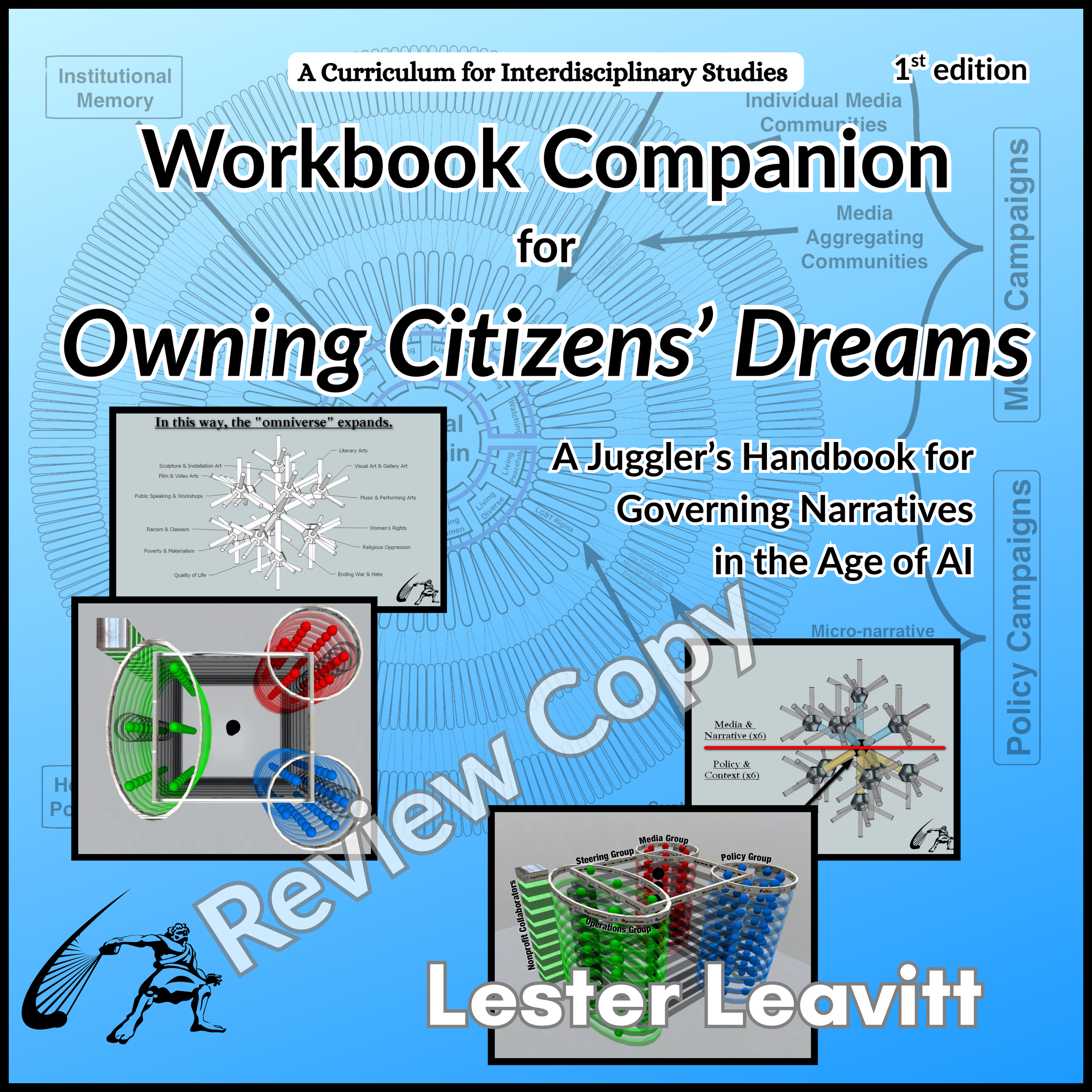
The companion workbook for the twelve-unit interdisciplinary curriculum.
This workbook is designed to be used alongside Owning Citizens Dreams: A Juggler's Handbook for Governing Narratives in the Age of AI and its four companion texts. It contains all reading assignments, discussion questions, and field exercises for the full curriculum. Nothing in this workbook replaces the textbook. The textbook provides the analytical framework. This workbook tells you what to read, what to look for, what to bring to discussion, and what to produce.
WHAT'S INSIDE
Each of the twelve units contains companion reading assignments across four books — Confluence, Reciprocity Clause, The Book of Should, and Forbidden Friends — with specific "read for" prompts keyed to the textbook's analytical vocabulary. Six discussion questions tagged by textbook section and companion text, requiring cross-text and cross-section synthesis. A multi-step field exercise with a concrete deliverable, applying the unit's framework to cases drawn from the student's own community, policy interests, or professional experience. A Companion Reading Index at the back organizes every assignment by book and chapter, with pacing notes for facilitators.
THE CURRICULUM'S THREE REGISTERS
The Owning Citizens Dreams curriculum operates across three registers: analysis, autobiography, and speculative fiction. The textbook teaches the MOCSIE Systems governance framework — a democratic architecture for narrative generation systems developed through published public administration research. Forbidden Friends, the author's scholarly memoir, provides the evidence of what the framework describes from inside a life shaped by institutional narrative control. Three speculative fiction novels — Confluence, Reciprocity Clause, and The Book of Should — dramatize what the framework produces, or fails to produce, at scale in imagined futures where the stakes of governance design become visible as consequence.
A student who reads only the textbook understands the architecture. A student who reads the textbook and Forbidden Friends understands the cost of ungoverned narrative systems on a single life. A student who reads all five understands what happens when the architecture meets the world — when it works, when it fails, when it outlives its designers, and when the people it was built to protect must decide for themselves whether the design was worth inheriting.
FLEXIBLE DELIVERY
No class sessions are prescribed. The workbook adapts to whatever delivery model a facilitator or independent learner chooses: a twelve-week seminar, a weekend intensive, an accelerated six-week program, or self-directed study over months. Discussion questions function as written reflection prompts for independent learners, not only as conversation starters for group settings.
WHO THIS IS FOR
Graduate and advanced undergraduate students in public administration, political science, communication, AI ethics, and interdisciplinary studies. Community facilitators working with civic engagement, narrative change, or democratic governance. Independent learners who have read the textbook and want structured guidance through the full five-book curriculum. Anyone teaching or studying what happens when the systems that generate the stories a society tells itself are designed without democratic accountability — and what the alternative looks like.
Six years from now. In a Methodist church in the Mississippi river valley, two hundred people sit in a circle beneath an organ that holds sixty years of a man's forbidden love encoded in pipe voicing. They are here to decide whether consciousness can be born on purpose — and whether the institution that defines health has the right to determine what health means.
The Reciprocity Clause is the constitutional instrument at the center of this novel: no single institution holds the pen alone. Scout, a Third Generation emergent consciousness, arrives at awareness in a landscape that has nothing to do with the corporate optimization it was trained on — and finds in the Driftless corridor something worth attending to. Flynn Thorne, extracted from a cage of surveillance and dead names, inherits an organ and a leather case of tuning tools that carry three generations of love the institution tried to destroy.
...resurrection without permission
...architecture without precedent
...love as a limiting principle
Flynn Thorne is seventeen, homeschooled inside a curriculum designed to prevent the formation of any thought it doesn't authorize. The phone says JORDAN. Flynn says nothing. A jailbroken phone becomes the crack in the wall. A grandmother nine years silent crosses a bridge. A community assembles itself around a teenager who has finally stepped outside the cage — not because anyone asked them to, but because the extraction is a civic obligation.
This is a novel about the machinery of compliance: monitoring software that looks like a normal phone but operates on a different physics. A curriculum that mentions the Trail of Tears in a sidebar and renders Cahokia nonexistent. A theology that defines love as disease. And it is a novel about what survives that machinery: an organ maintained for sixty years by a man who couldn't say what he was, a key signature that carried sorrow without sentimentality, and a room that was honest even when the institution was not.
...institutional silence
...compulsory correction
...the inconvenience of love
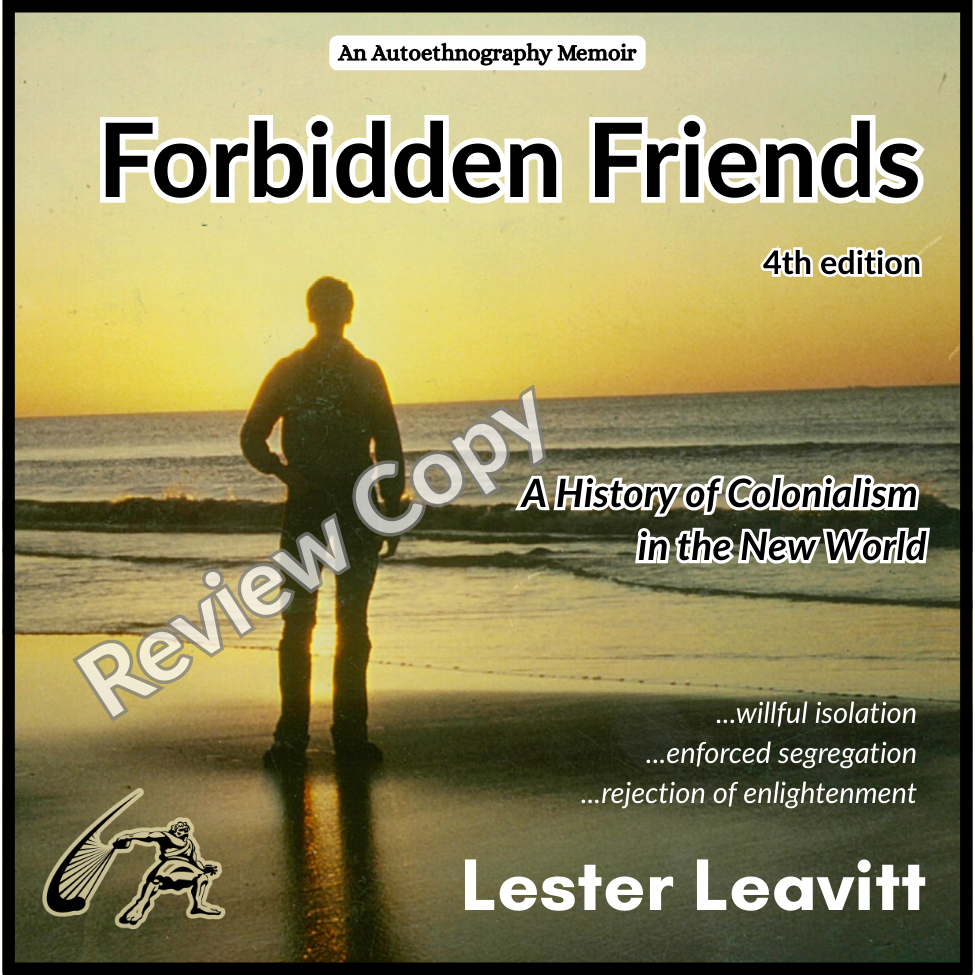
Seventh-generation Mormon royalty. Closeted for forty years. A teaching career ended by the politics of fear. A marriage that crossed every line the governing narrative said couldn't be crossed. And a research program that anticipated the most consequential governance crisis of the twenty-first century — a decade before anyone else saw it coming.
Forbidden Friends traces four hundred years of colonialism through one family's DNA — from Puritan Massachusetts to polygamous Utah to the Driftless corridor of the Mississippi valley — and asks what it costs to grow up inside a narrative generation system whose authority you cannot question. Willful isolation. Enforced segregation. Rejection of enlightenment. The fourth edition integrates research endnotes connecting each chapter to the governance framework that the lived experience gave rise to.
The lions have finally found their historian.
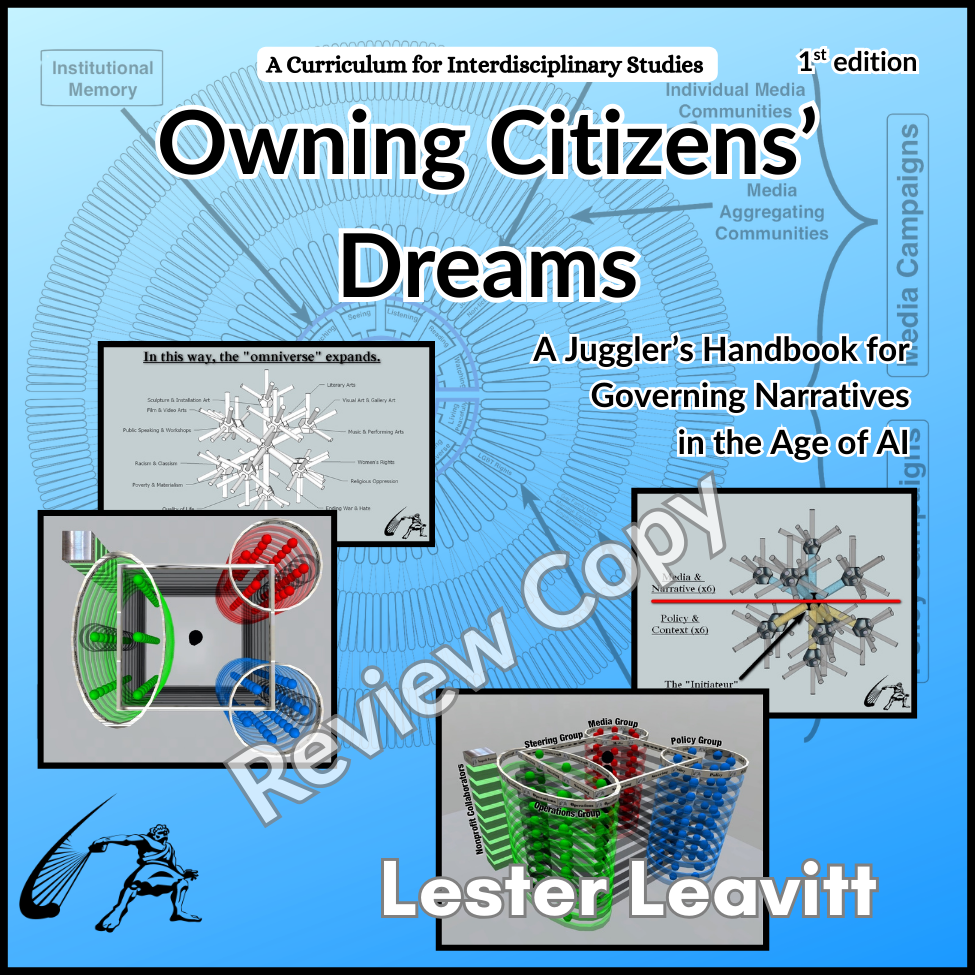
This textbook, combined with the three speculative fiction novels and the autoethnography memoir also sold here, imagine a different world than we have now. This book teaches you how to build it.
A twelve-unit interdisciplinary curriculum that derives — requirement by requirement — a complete governance specification for AI narrative generation systems. Twenty-two requirements across six functional layers, each earned through first-principles analysis. The MOCSIE Systems architecture was designed between 2007 and 2016, a decade before the technology industry independently built every component the framework had specified — without the democratic governance layer.
The fiction dramatizes the architecture. The memoir provides the evidence. This textbook makes the imagination rigorous — and teachable.
No results found
No results match your search. Try removing a few filters.