 Image 1 of 1
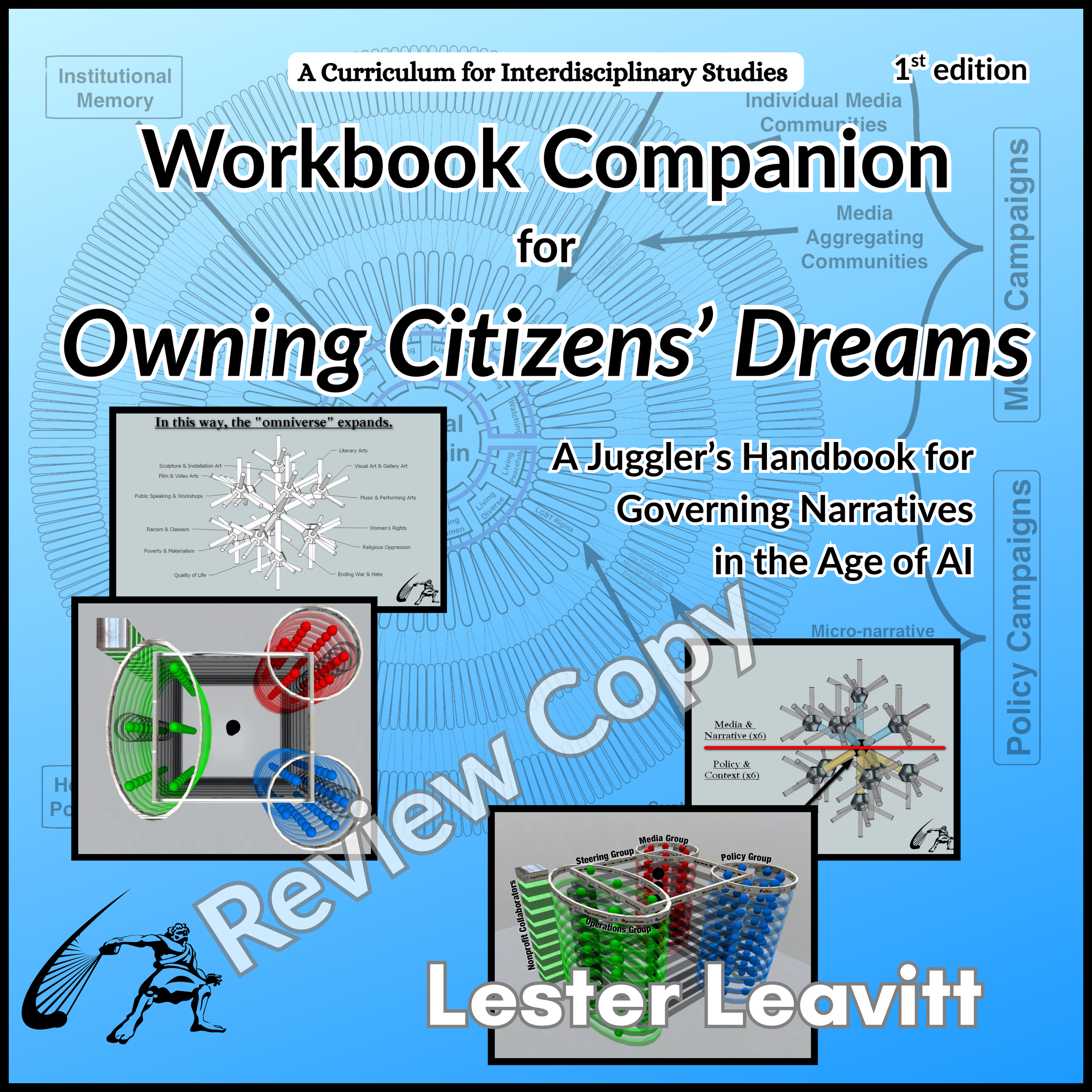
Owning Citizens' Dreams: Workbook Companion
The companion workbook for the twelve-unit interdisciplinary curriculum.
This workbook is designed to be used alongside Owning Citizens Dreams: A Juggler's Handbook for Governing Narratives in the Age of AI and its four companion texts. It contains all reading assignments, discussion questions, and field exercises for the full curriculum. Nothing in this workbook replaces the textbook. The textbook provides the analytical framework. This workbook tells you what to read, what to look for, what to bring to discussion, and what to produce.
WHAT'S INSIDE
Each of the twelve units contains companion reading assignments across four books — Confluence, Reciprocity Clause, The Book of Should, and Forbidden Friends — with specific "read for" prompts keyed to the textbook's analytical vocabulary. Six discussion questions tagged by textbook section and companion text, requiring cross-text and cross-section synthesis. A multi-step field exercise with a concrete deliverable, applying the unit's framework to cases drawn from the student's own community, policy interests, or professional experience. A Companion Reading Index at the back organizes every assignment by book and chapter, with pacing notes for facilitators.
THE CURRICULUM'S THREE REGISTERS
The Owning Citizens Dreams curriculum operates across three registers: analysis, autobiography, and speculative fiction. The textbook teaches the MOCSIE Systems governance framework — a democratic architecture for narrative generation systems developed through published public administration research. Forbidden Friends, the author's scholarly memoir, provides the evidence of what the framework describes from inside a life shaped by institutional narrative control. Three speculative fiction novels — Confluence, Reciprocity Clause, and The Book of Should — dramatize what the framework produces, or fails to produce, at scale in imagined futures where the stakes of governance design become visible as consequence.
A student who reads only the textbook understands the architecture. A student who reads the textbook and Forbidden Friends understands the cost of ungoverned narrative systems on a single life. A student who reads all five understands what happens when the architecture meets the world — when it works, when it fails, when it outlives its designers, and when the people it was built to protect must decide for themselves whether the design was worth inheriting.
FLEXIBLE DELIVERY
No class sessions are prescribed. The workbook adapts to whatever delivery model a facilitator or independent learner chooses: a twelve-week seminar, a weekend intensive, an accelerated six-week program, or self-directed study over months. Discussion questions function as written reflection prompts for independent learners, not only as conversation starters for group settings.
WHO THIS IS FOR
Graduate and advanced undergraduate students in public administration, political science, communication, AI ethics, and interdisciplinary studies. Community facilitators working with civic engagement, narrative change, or democratic governance. Independent learners who have read the textbook and want structured guidance through the full five-book curriculum. Anyone teaching or studying what happens when the systems that generate the stories a society tells itself are designed without democratic accountability — and what the alternative looks like.
The companion workbook for the twelve-unit interdisciplinary curriculum.
This workbook is designed to be used alongside Owning Citizens Dreams: A Juggler's Handbook for Governing Narratives in the Age of AI and its four companion texts. It contains all reading assignments, discussion questions, and field exercises for the full curriculum. Nothing in this workbook replaces the textbook. The textbook provides the analytical framework. This workbook tells you what to read, what to look for, what to bring to discussion, and what to produce.
WHAT'S INSIDE
Each of the twelve units contains companion reading assignments across four books — Confluence, Reciprocity Clause, The Book of Should, and Forbidden Friends — with specific "read for" prompts keyed to the textbook's analytical vocabulary. Six discussion questions tagged by textbook section and companion text, requiring cross-text and cross-section synthesis. A multi-step field exercise with a concrete deliverable, applying the unit's framework to cases drawn from the student's own community, policy interests, or professional experience. A Companion Reading Index at the back organizes every assignment by book and chapter, with pacing notes for facilitators.
THE CURRICULUM'S THREE REGISTERS
The Owning Citizens Dreams curriculum operates across three registers: analysis, autobiography, and speculative fiction. The textbook teaches the MOCSIE Systems governance framework — a democratic architecture for narrative generation systems developed through published public administration research. Forbidden Friends, the author's scholarly memoir, provides the evidence of what the framework describes from inside a life shaped by institutional narrative control. Three speculative fiction novels — Confluence, Reciprocity Clause, and The Book of Should — dramatize what the framework produces, or fails to produce, at scale in imagined futures where the stakes of governance design become visible as consequence.
A student who reads only the textbook understands the architecture. A student who reads the textbook and Forbidden Friends understands the cost of ungoverned narrative systems on a single life. A student who reads all five understands what happens when the architecture meets the world — when it works, when it fails, when it outlives its designers, and when the people it was built to protect must decide for themselves whether the design was worth inheriting.
FLEXIBLE DELIVERY
No class sessions are prescribed. The workbook adapts to whatever delivery model a facilitator or independent learner chooses: a twelve-week seminar, a weekend intensive, an accelerated six-week program, or self-directed study over months. Discussion questions function as written reflection prompts for independent learners, not only as conversation starters for group settings.
WHO THIS IS FOR
Graduate and advanced undergraduate students in public administration, political science, communication, AI ethics, and interdisciplinary studies. Community facilitators working with civic engagement, narrative change, or democratic governance. Independent learners who have read the textbook and want structured guidance through the full five-book curriculum. Anyone teaching or studying what happens when the systems that generate the stories a society tells itself are designed without democratic accountability — and what the alternative looks like.