Sale Price:
$0.00
Original Price:
$9.95
In the 2024 general election, 10,342 voters across Illinois House District 89 showed up to the polls, looked at the ballot line for state representative, and left it blank. No write-in. No protest vote. Just silence — because there was only one name on the ballot, and nobody had bothered to offer an alternative.
Masters of Extraction argues that this silence is not apathy. It is the product of a system designed to harvest political consent from communities that have been structurally abandoned — the same way a mining company harvests lead ore from a hillside and leaves the arsenic in the ground.
The word is extraction. Not taxation. Not neglect. Not "the way things are." You already know what extraction looks like when it applies to minerals, labor, and land. This book makes the case that the same word applies to your vote.
Beginning in the rural precincts of northwestern Illinois — seven counties, 120 precincts, 95 miles — the book documents the architecture of disenfranchisement at the most local level: vacant committeeperson seats, uncontested races, and a district packed so that both parties benefit from the absence of competition. Then the lens widens across five thousand years of human governance, identifying five extraction mechanisms and six self-reinforcing cycles all running simultaneously in rural America today.
The historical tour moves through Bacon's Rebellion, Constantine's capture of early Christianity, the Grange becoming the Farm Bureau, Father Coughlin's microphone, and the deliberate convergence of blame the cities and blame the godless into the binary the rural reader currently votes inside — showing that moral clarity is real but always captured, and that the Masters of Extraction are always standing at the pivot point, ready to ride the pendulum in either direction.
Grounded in precinct-level election data, peer-reviewed research on ballot access, and a lawsuit filed in Sangamon County on April 28, 2026, Masters of Extraction argues that competitive democracy must be rebuilt from the bottom up — one precinct, one petition, one uncontested seat at a time. Pragmatism is not compromise. It is the refusal to burn down the house to win the argument.
In the 2024 general election, 10,342 voters across Illinois House District 89 showed up to the polls, looked at the ballot line for state representative, and left it blank. No write-in. No protest vote. Just silence — because there was only one name on the ballot, and nobody had bothered to offer an alternative.
Masters of Extraction argues that this silence is not apathy. It is the product of a system designed to harvest political consent from communities that have been structurally abandoned — the same way a mining company harvests lead ore from a hillside and leaves the arsenic in the ground.
The word is extraction. Not taxation. Not neglect. Not "the way things are." You already know what extraction looks like when it applies to minerals, labor, and land. This book makes the case that the same word applies to your vote.
Beginning in the rural precincts of northwestern Illinois — seven counties, 120 precincts, 95 miles — the book documents the architecture of disenfranchisement at the most local level: vacant committeeperson seats, uncontested races, and a district packed so that both parties benefit from the absence of competition. Then the lens widens across five thousand years of human governance, identifying five extraction mechanisms and six self-reinforcing cycles all running simultaneously in rural America today.
The historical tour moves through Bacon's Rebellion, Constantine's capture of early Christianity, the Grange becoming the Farm Bureau, Father Coughlin's microphone, and the deliberate convergence of blame the cities and blame the godless into the binary the rural reader currently votes inside — showing that moral clarity is real but always captured, and that the Masters of Extraction are always standing at the pivot point, ready to ride the pendulum in either direction.
Grounded in precinct-level election data, peer-reviewed research on ballot access, and a lawsuit filed in Sangamon County on April 28, 2026, Masters of Extraction argues that competitive democracy must be rebuilt from the bottom up — one precinct, one petition, one uncontested seat at a time. Pragmatism is not compromise. It is the refusal to burn down the house to win the argument.
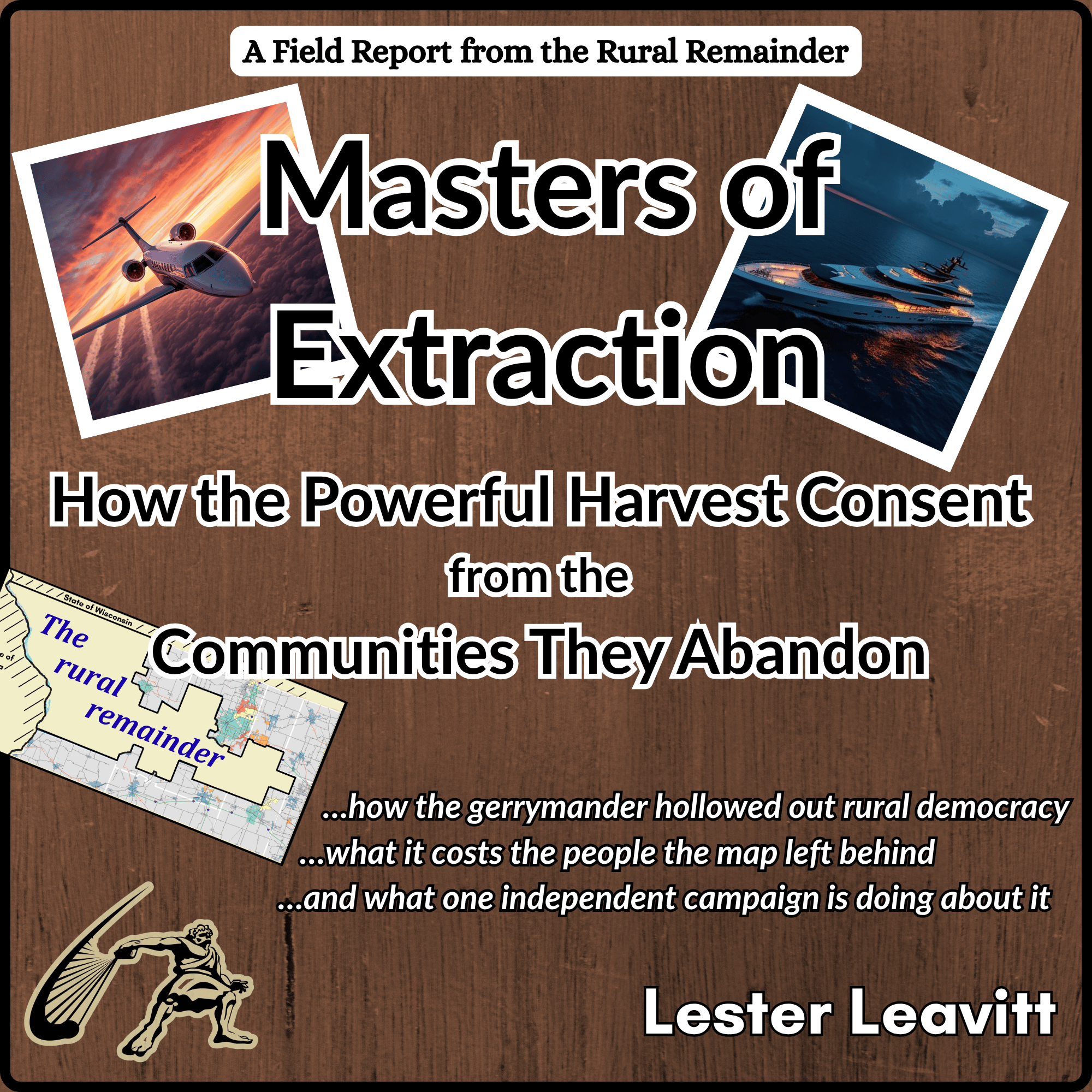 Image 1 of 1