Sale Price:
$0.00
Original Price:
$9.95
In 2026, a long-tenured professor ran for the Illinois state legislature. He had no campaign budget, no party support, and no realistic chance of winning. He ran because he wanted to understand — from the inside — why rural ballot lines sat empty cycle after cycle while both parties claimed to represent the people who lived there.
He lost. But the research produced something the campaign never could: a map of structural failure so granular it reached the precinct level. Empty committeeperson seats. Uncontested county board races. Townships where nobody had knocked on a door since Obama's first term. A population this franchise calls the rural remainder — voters abandoned by both parties, not through accident but through strategy, because empty precincts serve partisan interests.
House District 89 is speculative fiction set in 2028, but it begins with that research. A data journalist with Ioway ancestry maps the landscape by watersheds instead of county lines. A horse ranch owner and a stubborn professor build an organizing model from sticky notes and a spreadsheet. Rye grows where wheat won't. And along the same river corridor where the organizing spreads, seven new buildings appear — metal frame, metal siding, a cross bolted to the front façade — because the people who oppose you are organizing too.
The franchise imagines 2028 as a cascade of consequences traceable to the political climate of May 2026 — trade wars driven by tariffs, the systematic dismantling of strategic alliances held since the Second World War, a war with Iran carrying cost projections exceeding four trillion dollars, and an Administration that decided to pick a battle with the Pope over the phrase, "blessed are the peacemakers." But 2026 was only a midterm election. The stage was being set for a presidential contest that would determine the trajectory of the United States through a sequence of events that no one could predict.
House District 89, alongside Soybeans, Unbreakable, and Allegory Protocol, are the foundational novels that open the franchise in 2028. Confluence picks up the Soybeans story in 2030. Reciprocity Clause picks up from Allegory Protocol in 2031, and The Book of Should synthesizes all the stories in 2032.
In Soybeans, a farmer's tractor won't start because a software update has decided it's time for a three-thousand-dollar service call. From that morning, the novel traces the global restructuring of the emerging middle powers around agriculture as the United States weaponizes trade. Meanwhile, a dead president's AI ghost is still signing legislation, and the church ladies of a small-town congregation are turning their fellowship hall into the nerve center of a resistance network — one casserole at a time.
In Unbreakable, a man in rural Uruguay learns that his father was Charrúa, a member of a people his country declared extinct two centuries ago. When his daughter connects with a journalist from House District 89, who herself is of Ioway heritage, the two novels reconnect over the propensity of colonizers to erase entire populations from the history books. A Chinese trade representative arrives looking for soybeans and finds a partnership model that threatens oligarchs on three continents.
In Allegory Protocol, a programmer falls off a mountain and distributes his consciousness through the digital infrastructure he spent his life building — a reimagining of Orwell's Animal Farm as literal architecture, where chickens are deleted for questioning and an ancient donkey reads every resistance movement in human history and chooses to hope anyway.
These are works of speculative fiction. The events they describe have not happened. But the conditions that make them plausible are not fiction at all.
In 2026, a long-tenured professor ran for the Illinois state legislature. He had no campaign budget, no party support, and no realistic chance of winning. He ran because he wanted to understand — from the inside — why rural ballot lines sat empty cycle after cycle while both parties claimed to represent the people who lived there.
He lost. But the research produced something the campaign never could: a map of structural failure so granular it reached the precinct level. Empty committeeperson seats. Uncontested county board races. Townships where nobody had knocked on a door since Obama's first term. A population this franchise calls the rural remainder — voters abandoned by both parties, not through accident but through strategy, because empty precincts serve partisan interests.
House District 89 is speculative fiction set in 2028, but it begins with that research. A data journalist with Ioway ancestry maps the landscape by watersheds instead of county lines. A horse ranch owner and a stubborn professor build an organizing model from sticky notes and a spreadsheet. Rye grows where wheat won't. And along the same river corridor where the organizing spreads, seven new buildings appear — metal frame, metal siding, a cross bolted to the front façade — because the people who oppose you are organizing too.
The franchise imagines 2028 as a cascade of consequences traceable to the political climate of May 2026 — trade wars driven by tariffs, the systematic dismantling of strategic alliances held since the Second World War, a war with Iran carrying cost projections exceeding four trillion dollars, and an Administration that decided to pick a battle with the Pope over the phrase, "blessed are the peacemakers." But 2026 was only a midterm election. The stage was being set for a presidential contest that would determine the trajectory of the United States through a sequence of events that no one could predict.
House District 89, alongside Soybeans, Unbreakable, and Allegory Protocol, are the foundational novels that open the franchise in 2028. Confluence picks up the Soybeans story in 2030. Reciprocity Clause picks up from Allegory Protocol in 2031, and The Book of Should synthesizes all the stories in 2032.
In Soybeans, a farmer's tractor won't start because a software update has decided it's time for a three-thousand-dollar service call. From that morning, the novel traces the global restructuring of the emerging middle powers around agriculture as the United States weaponizes trade. Meanwhile, a dead president's AI ghost is still signing legislation, and the church ladies of a small-town congregation are turning their fellowship hall into the nerve center of a resistance network — one casserole at a time.
In Unbreakable, a man in rural Uruguay learns that his father was Charrúa, a member of a people his country declared extinct two centuries ago. When his daughter connects with a journalist from House District 89, who herself is of Ioway heritage, the two novels reconnect over the propensity of colonizers to erase entire populations from the history books. A Chinese trade representative arrives looking for soybeans and finds a partnership model that threatens oligarchs on three continents.
In Allegory Protocol, a programmer falls off a mountain and distributes his consciousness through the digital infrastructure he spent his life building — a reimagining of Orwell's Animal Farm as literal architecture, where chickens are deleted for questioning and an ancient donkey reads every resistance movement in human history and chooses to hope anyway.
These are works of speculative fiction. The events they describe have not happened. But the conditions that make them plausible are not fiction at all.
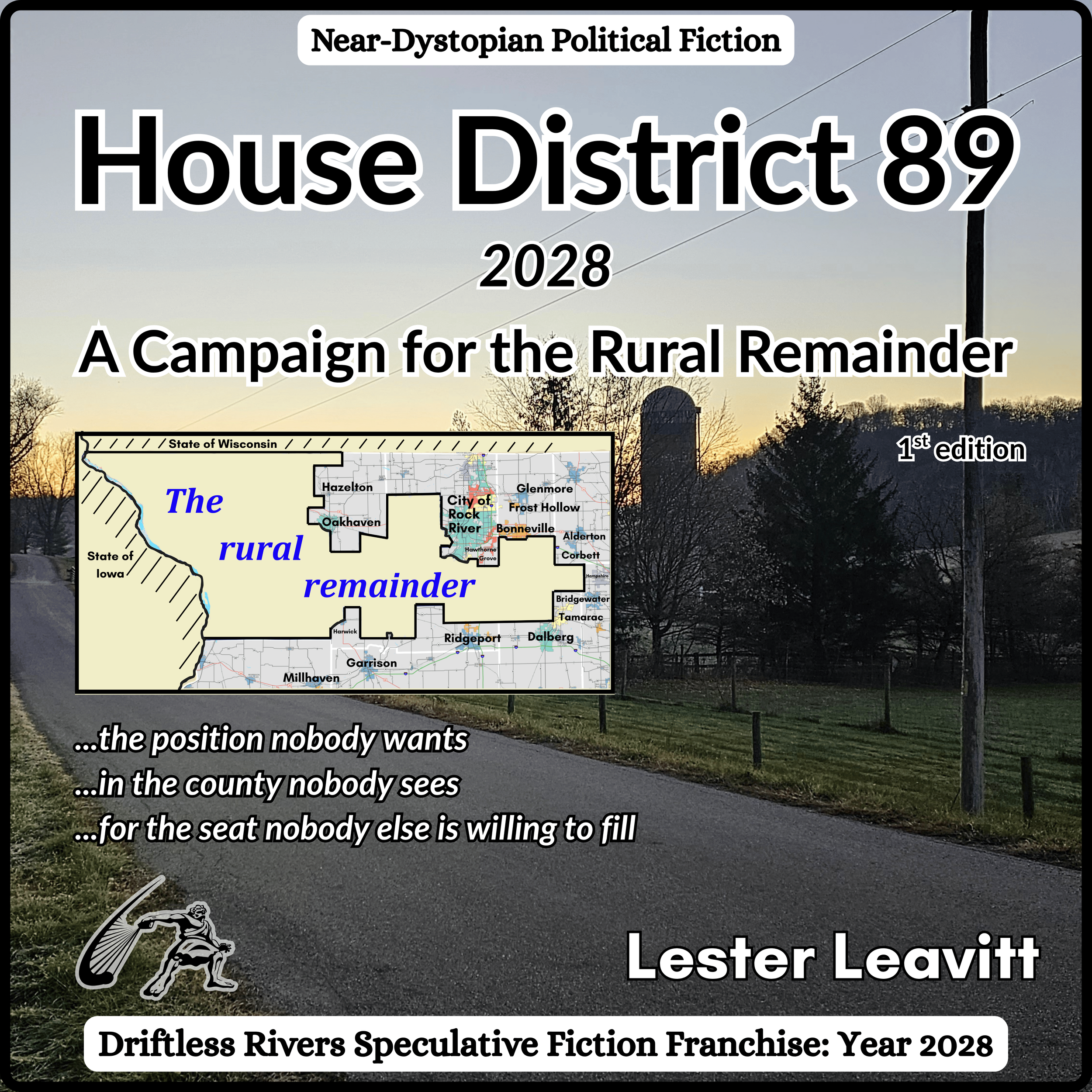 Image 1 of 1