Can a voter lose the right to run for office simply by voting?
In March 2026, Lester Leavitt voted for a friend on the Republican ballot in the only competitive primary available in his district — because every Democratic candidate in local and regional races was running unopposed. In April, he discovered that a statute he'd never heard of had silently forfeited his right to run as an independent candidate for State Representative. No one told him at the polling place. No one tells anyone. You don’t see it in the Candidate’s Guide until you’re “deep in the weeds.”
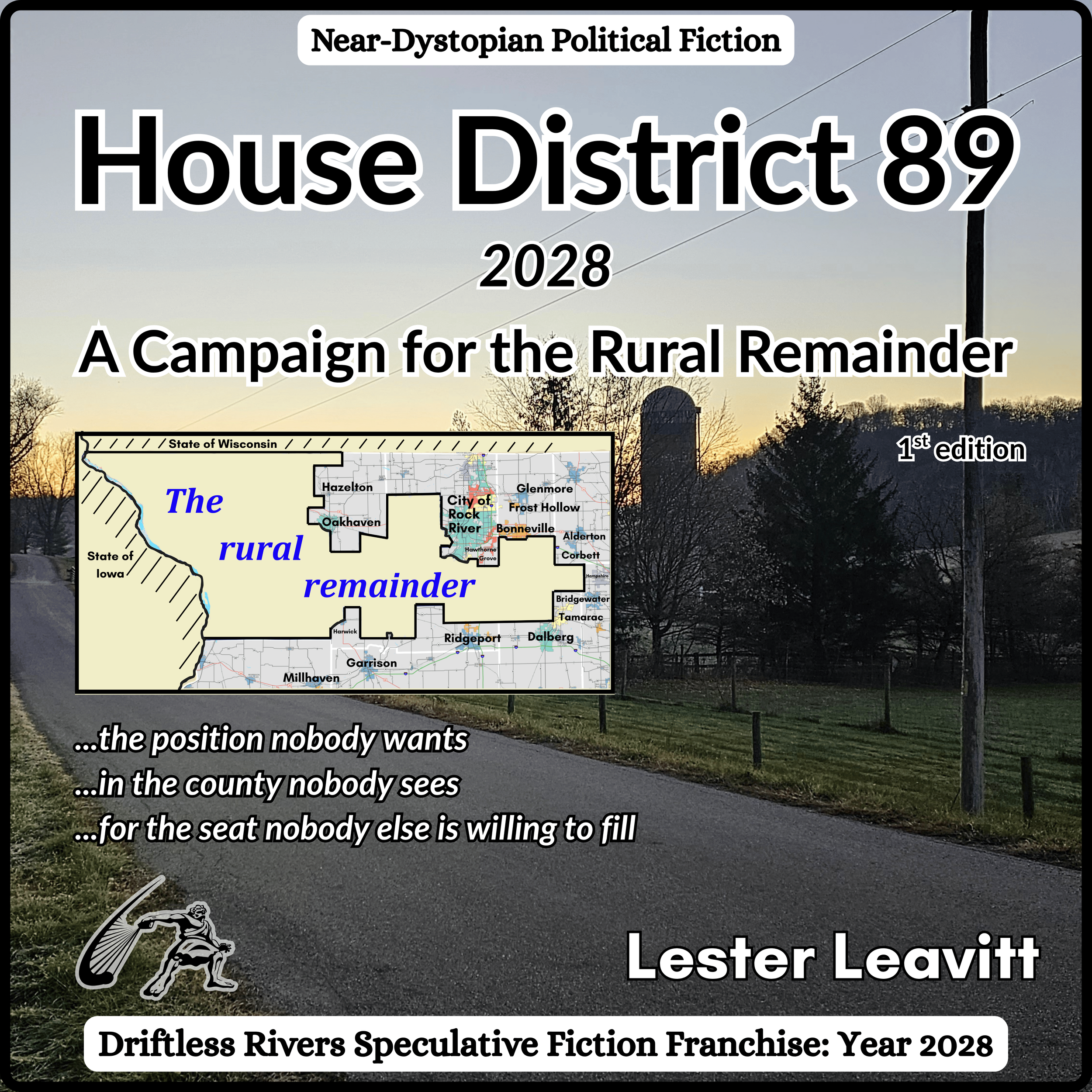
This Verified Complaint, filed in the Circuit Court of the Seventh Judicial Circuit, Sangamon County, Illinois, documents how the combined operation of gerrymandered maps, anti-slating legislation, a 2,957-signature petition threshold across 95 miles of rural northwest Illinois, and 10 ILCS 5/7-43 produces a closed system in which no challenger can reach the ballot through any available pathway — ensuring that House Minority Leader Tony McCombie is returned to office for a third consecutive election without opposition.
The complaint raises three constitutional claims under the First and Fourteenth Amendments: the right to seek office, forfeiture of a constitutional right without notice, and a novel equal protection theory arguing that voters in rural packed districts suffer a qualitatively different and more severe harm than voters in urban cracked districts — a structural injury that operates identically in Democratic-gerrymandered Illinois and Republican-gerrymandered Alabama, Mississippi, and Louisiana.
The equal protection argument introduces the concept of the "adjacent competitive ecosystem" — the institutional infrastructure of a nearby population center that sustains competitive elections in surrounding rural counties until a mapmaker walls it off behind a district line — and documents the multiplier effect by which one act of cracking a single city kills competitive democracy in every rural region around it.
50 numbered paragraphs. Three constitutional counts. One question the court has not yet been asked: when the architecture guarantees the outcome, is it still an election?
Leavitt v. Illinois State Board of Elections, Circuit Court of the Seventh Judicial Circuit, Sangamon County, Illinois, 2026.
Can a voter lose the right to run for office simply by voting?
In March 2026, Lester Leavitt voted for a friend on the Republican ballot in the only competitive primary available in his district — because every Democratic candidate in local and regional races was running unopposed. In April, he discovered that a statute he'd never heard of had silently forfeited his right to run as an independent candidate for State Representative. No one told him at the polling place. No one tells anyone. You don’t see it in the Candidate’s Guide until you’re “deep in the weeds.”
This Verified Complaint, filed in the Circuit Court of the Seventh Judicial Circuit, Sangamon County, Illinois, documents how the combined operation of gerrymandered maps, anti-slating legislation, a 2,957-signature petition threshold across 95 miles of rural northwest Illinois, and 10 ILCS 5/7-43 produces a closed system in which no challenger can reach the ballot through any available pathway — ensuring that House Minority Leader Tony McCombie is returned to office for a third consecutive election without opposition.
The complaint raises three constitutional claims under the First and Fourteenth Amendments: the right to seek office, forfeiture of a constitutional right without notice, and a novel equal protection theory arguing that voters in rural packed districts suffer a qualitatively different and more severe harm than voters in urban cracked districts — a structural injury that operates identically in Democratic-gerrymandered Illinois and Republican-gerrymandered Alabama, Mississippi, and Louisiana.
The equal protection argument introduces the concept of the "adjacent competitive ecosystem" — the institutional infrastructure of a nearby population center that sustains competitive elections in surrounding rural counties until a mapmaker walls it off behind a district line — and documents the multiplier effect by which one act of cracking a single city kills competitive democracy in every rural region around it.
50 numbered paragraphs. Three constitutional counts. One question the court has not yet been asked: when the architecture guarantees the outcome, is it still an election?
Leavitt v. Illinois State Board of Elections, Circuit Court of the Seventh Judicial Circuit, Sangamon County, Illinois, 2026.
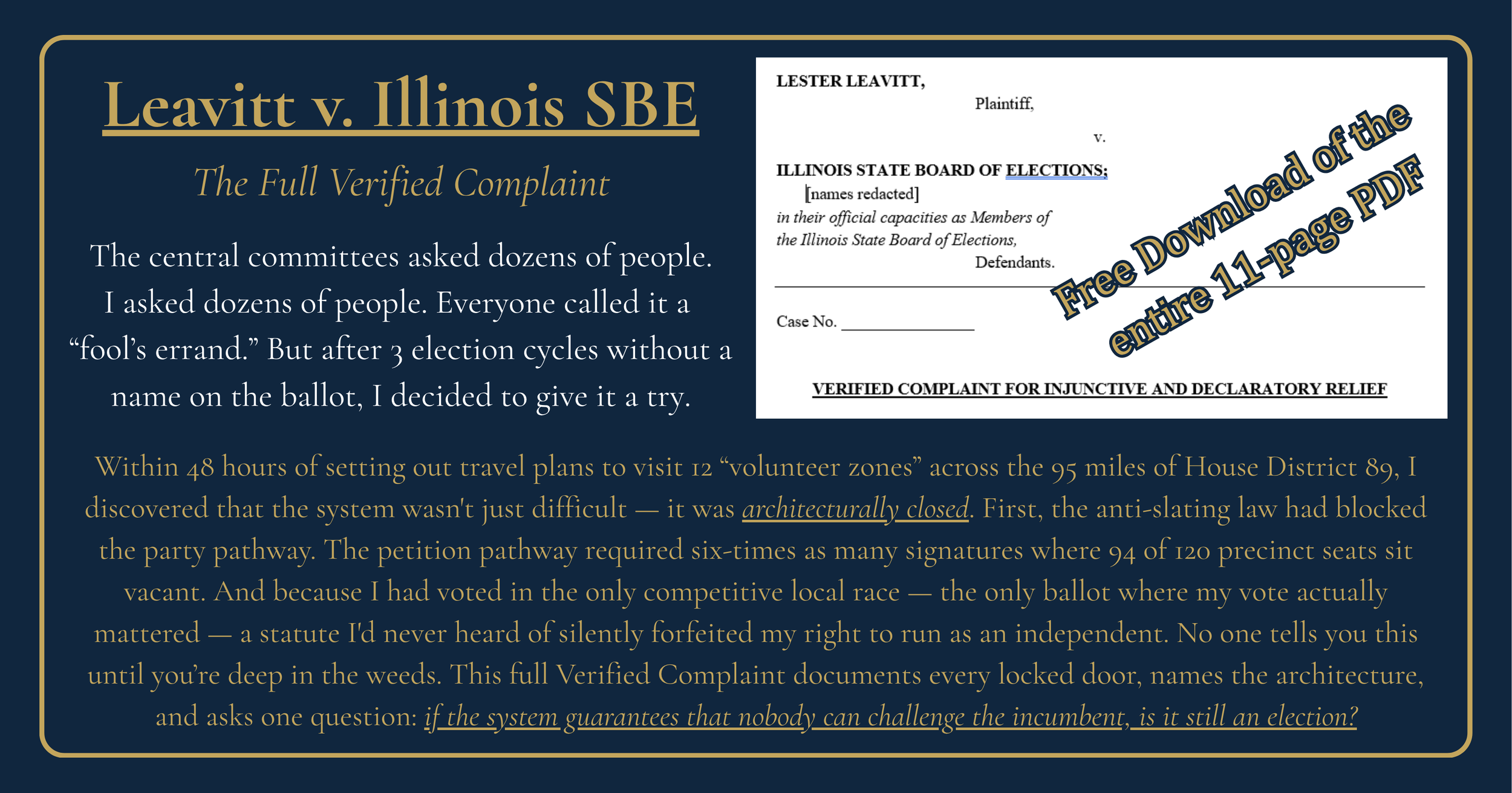 Image 1 of 1