In 2024, the Sangamon County Circuit Court did something rare: it enjoined enforcement of a ballot access statute mid-cycle so that candidates could appear on the ballot while the constitutional question was litigated. That case was Collazo v. Illinois State Board of Elections. This motion asks the same court to do it again.
Lester Leavitt discovered on April 19, 2026, that a statute he'd never heard of — 10 ILCS 5/7-43 — had silently forfeited his right to run as an independent candidate for State Representative because he voted in the March primary. He voted the only competitive ballot available in a district where every Democratic candidate was running unopposed. No one at the polling place told him that voting would cost him the right to run.
The motion walks five arguments in sequence. Likelihood of success on the merits — under the Anderson-Burdick framework, a total bar to candidacy triggered by the act of voting is a severe burden that the state's anti-spoiler interest cannot justify in a district where there was no opposing-party primary to manipulate. Irreparable harm — the filing deadline is May 26, and an election cannot be re-run. The litigation itself consumed the signature-collection window — every day from April 19 through May 26 had already been calendared for zone-specific appearances across 12 volunteer zones anchored by church congregations, and the lawsuit shut that operational calendar down. Balance of equities — if the injunction is granted and Plaintiff is wrong, one extra name appeared on one ballot; if it's denied and Plaintiff is right, a fourth consecutive uncontested election is irremediable. Public interest — 10,342 voters refused to ratify an uncontested race in 2024, and the legislature's own task force voted not to fix the system.
The motion introduces a proportional signature reduction formula: if the court grants N collection days, the requirement drops to N/85 of 2,957 — because the final five days of the 90-day window were never collection days, they were notarization logistics across 95 miles, as documented in the three attached exhibit maps showing the full campaign zone calendar.
Three exhibits. One formula. One question the Collazo court already answered: when the deadline will make the harm permanent, you act before the deadline.
Filed in the Circuit Court of the Seventh Judicial Circuit, Sangamon County, Illinois, 2026.
In 2024, the Sangamon County Circuit Court did something rare: it enjoined enforcement of a ballot access statute mid-cycle so that candidates could appear on the ballot while the constitutional question was litigated. That case was Collazo v. Illinois State Board of Elections. This motion asks the same court to do it again.
Lester Leavitt discovered on April 19, 2026, that a statute he'd never heard of — 10 ILCS 5/7-43 — had silently forfeited his right to run as an independent candidate for State Representative because he voted in the March primary. He voted the only competitive ballot available in a district where every Democratic candidate was running unopposed. No one at the polling place told him that voting would cost him the right to run.
The motion walks five arguments in sequence. Likelihood of success on the merits — under the Anderson-Burdick framework, a total bar to candidacy triggered by the act of voting is a severe burden that the state's anti-spoiler interest cannot justify in a district where there was no opposing-party primary to manipulate. Irreparable harm — the filing deadline is May 26, and an election cannot be re-run. The litigation itself consumed the signature-collection window — every day from April 19 through May 26 had already been calendared for zone-specific appearances across 12 volunteer zones anchored by church congregations, and the lawsuit shut that operational calendar down. Balance of equities — if the injunction is granted and Plaintiff is wrong, one extra name appeared on one ballot; if it's denied and Plaintiff is right, a fourth consecutive uncontested election is irremediable. Public interest — 10,342 voters refused to ratify an uncontested race in 2024, and the legislature's own task force voted not to fix the system.
The motion introduces a proportional signature reduction formula: if the court grants N collection days, the requirement drops to N/85 of 2,957 — because the final five days of the 90-day window were never collection days, they were notarization logistics across 95 miles, as documented in the three attached exhibit maps showing the full campaign zone calendar.
Three exhibits. One formula. One question the Collazo court already answered: when the deadline will make the harm permanent, you act before the deadline.
Filed in the Circuit Court of the Seventh Judicial Circuit, Sangamon County, Illinois, 2026.
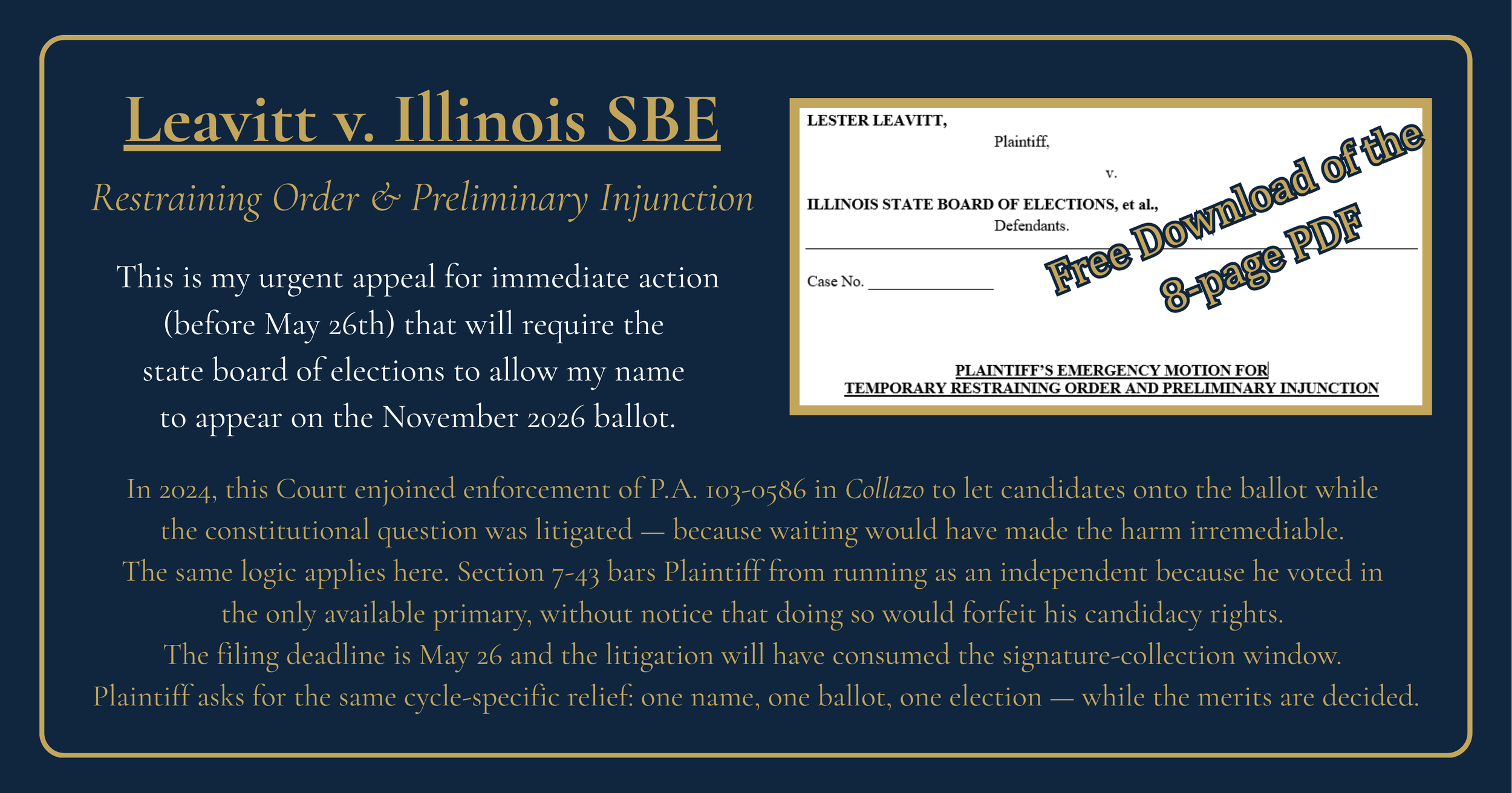 Image 1 of 1