This is the document that started the conversation.
Before the Verified Complaint was drafted, before the Motion for TRO was filed, this Statement of Facts was emailed to the Liberty Justice Center, the ACLU of Illinois, FairVote Illinois, Democracy Defenders Action, and the Illinois State Bar Association — asking one question: will anyone help?
Written in the classical WHEREAS format, the Statement builds a chain of 27 clauses across eight sections, each one adding weight until the conclusion becomes inevitable. A gerrymandered district. Three unopposed elections. 94 vacant committeeperson seats. A voter who pulled the only competitive ballot available and unknowingly forfeited the right to run. A signature threshold six times higher than what a partisan candidate faces — imposed on the one type of candidate who has no party infrastructure to help collect them. A bipartisan task force that studied ranked-choice voting and voted not to proceed. And a region called Forgottonia that has been trying to tell Springfield it's been abandoned since the 1970s.
The Statement introduces the rural packed district theory — the argument that cracking one city doesn't create one victim but five, because every rural county that depended on that city's institutional infrastructure for competitive elections loses its democracy at every level when the mapmaker walls it off behind a district line. It draws structural parallels between Carroll County, Illinois, and Wilcox County, Alabama — different parties, different races, same architecture, same collapse.
It closes with a tiered request for relief: waive the signature requirement entirely, or proportionately reduce it to N/85 of 2,957 based on the effective collection days remaining — because the final five days of the circulation window were never signature days. They were notarization logistics across 12 volunteer zones spanning 95 miles of rural towns.
This is the document you send to someone who needs to understand, in one reading, why a voter in rural Illinois had to file a lawsuit to get his name on a ballot.
Prepared April 21, 2026. Eight sections. 27 WHEREAS clauses. One closed system.
This is the document that started the conversation.
Before the Verified Complaint was drafted, before the Motion for TRO was filed, this Statement of Facts was emailed to the Liberty Justice Center, the ACLU of Illinois, FairVote Illinois, Democracy Defenders Action, and the Illinois State Bar Association — asking one question: will anyone help?
Written in the classical WHEREAS format, the Statement builds a chain of 27 clauses across eight sections, each one adding weight until the conclusion becomes inevitable. A gerrymandered district. Three unopposed elections. 94 vacant committeeperson seats. A voter who pulled the only competitive ballot available and unknowingly forfeited the right to run. A signature threshold six times higher than what a partisan candidate faces — imposed on the one type of candidate who has no party infrastructure to help collect them. A bipartisan task force that studied ranked-choice voting and voted not to proceed. And a region called Forgottonia that has been trying to tell Springfield it's been abandoned since the 1970s.
The Statement introduces the rural packed district theory — the argument that cracking one city doesn't create one victim but five, because every rural county that depended on that city's institutional infrastructure for competitive elections loses its democracy at every level when the mapmaker walls it off behind a district line. It draws structural parallels between Carroll County, Illinois, and Wilcox County, Alabama — different parties, different races, same architecture, same collapse.
It closes with a tiered request for relief: waive the signature requirement entirely, or proportionately reduce it to N/85 of 2,957 based on the effective collection days remaining — because the final five days of the circulation window were never signature days. They were notarization logistics across 12 volunteer zones spanning 95 miles of rural towns.
This is the document you send to someone who needs to understand, in one reading, why a voter in rural Illinois had to file a lawsuit to get his name on a ballot.
Prepared April 21, 2026. Eight sections. 27 WHEREAS clauses. One closed system.
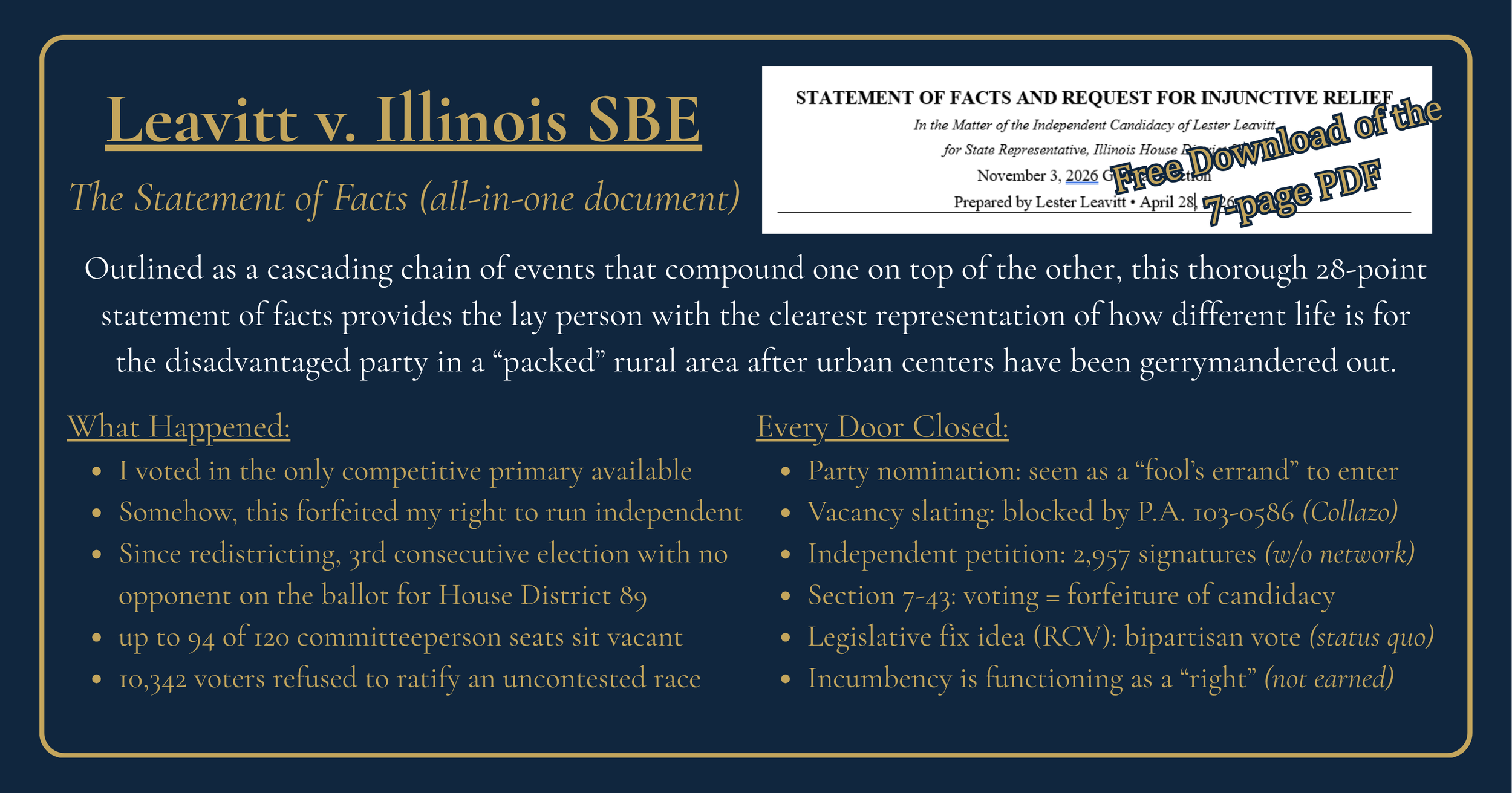 Image 1 of 1