If the emergency motion is about one candidate on one ballot, this memorandum is about what the system should look like so that no candidate has to file a lawsuit to get there.
The Memorandum on Proposed Permanent Relief traces the entire architecture of exclusion back to a single design choice in the Illinois Election Code: the requirement that a voter must select a partisan ballot to participate in the March primary. Illinois compounds this choice with a second — unlike most states, Illinois has no party registration. A voter doesn't declare a party when registering. The voter declares it, unknowingly, by requesting a ballot at the polling place. That act of requesting a ballot simultaneously affiliates the voter with a party and forfeits the right to run as an independent — in one motion, with zero notice, at a moment the voter believes they are simply voting.
From that root, the memorandum traces five steps of escalating exclusion: independents are excluded from the primary entirely. The state creates an alternative petition pathway but imposes a signature threshold 5.9 times higher than the partisan threshold. Section 7-43 bars anyone who participated in the partisan primary from using the petition pathway. In gerrymandered rural districts, the voter's "choice" of ballot is no choice at all. And at no step does anyone disclose the consequences.
The proposed permanent relief rests on two proportionality principles, both keyed to a single objective trigger — did a candidate of the disadvantaged party file in the preceding primary?
If no: reduce the independent signature threshold to the partisan level (500 instead of 2,957), and suspend Section 7-43 so that voters who participated in the only available primary are not barred from running as independents.
The memorandum demonstrates why both principles are necessary — without the signature reduction, the barrier is insurmountable even for a candidate who preserved the right to run by staying home in March; without the 7-43 suspension, every civically engaged voter who participated in the primary is disqualified. It then establishes four structural virtues: the remedy is self-executing, narrowly targeted to uncontested districts only, built on the legislature's own standards applied symmetrically, and party-neutral — protecting independent challengers in Alabama and Mississippi as readily as in Illinois.
The closing line: "The question before the Court on the emergency motion is whether one candidate should be allowed onto one ballot in one election. The question this memorandum addresses is what the system should look like so that no candidate has to file a lawsuit to get there."
Prepared for the Circuit Court of the Seventh Judicial Circuit, Sangamon County, Illinois, 2026.
If the emergency motion is about one candidate on one ballot, this memorandum is about what the system should look like so that no candidate has to file a lawsuit to get there.
The Memorandum on Proposed Permanent Relief traces the entire architecture of exclusion back to a single design choice in the Illinois Election Code: the requirement that a voter must select a partisan ballot to participate in the March primary. Illinois compounds this choice with a second — unlike most states, Illinois has no party registration. A voter doesn't declare a party when registering. The voter declares it, unknowingly, by requesting a ballot at the polling place. That act of requesting a ballot simultaneously affiliates the voter with a party and forfeits the right to run as an independent — in one motion, with zero notice, at a moment the voter believes they are simply voting.
From that root, the memorandum traces five steps of escalating exclusion: independents are excluded from the primary entirely. The state creates an alternative petition pathway but imposes a signature threshold 5.9 times higher than the partisan threshold. Section 7-43 bars anyone who participated in the partisan primary from using the petition pathway. In gerrymandered rural districts, the voter's "choice" of ballot is no choice at all. And at no step does anyone disclose the consequences.
The proposed permanent relief rests on two proportionality principles, both keyed to a single objective trigger — did a candidate of the disadvantaged party file in the preceding primary?
If no: reduce the independent signature threshold to the partisan level (500 instead of 2,957), and suspend Section 7-43 so that voters who participated in the only available primary are not barred from running as independents.
The memorandum demonstrates why both principles are necessary — without the signature reduction, the barrier is insurmountable even for a candidate who preserved the right to run by staying home in March; without the 7-43 suspension, every civically engaged voter who participated in the primary is disqualified. It then establishes four structural virtues: the remedy is self-executing, narrowly targeted to uncontested districts only, built on the legislature's own standards applied symmetrically, and party-neutral — protecting independent challengers in Alabama and Mississippi as readily as in Illinois.
The closing line: "The question before the Court on the emergency motion is whether one candidate should be allowed onto one ballot in one election. The question this memorandum addresses is what the system should look like so that no candidate has to file a lawsuit to get there."
Prepared for the Circuit Court of the Seventh Judicial Circuit, Sangamon County, Illinois, 2026.
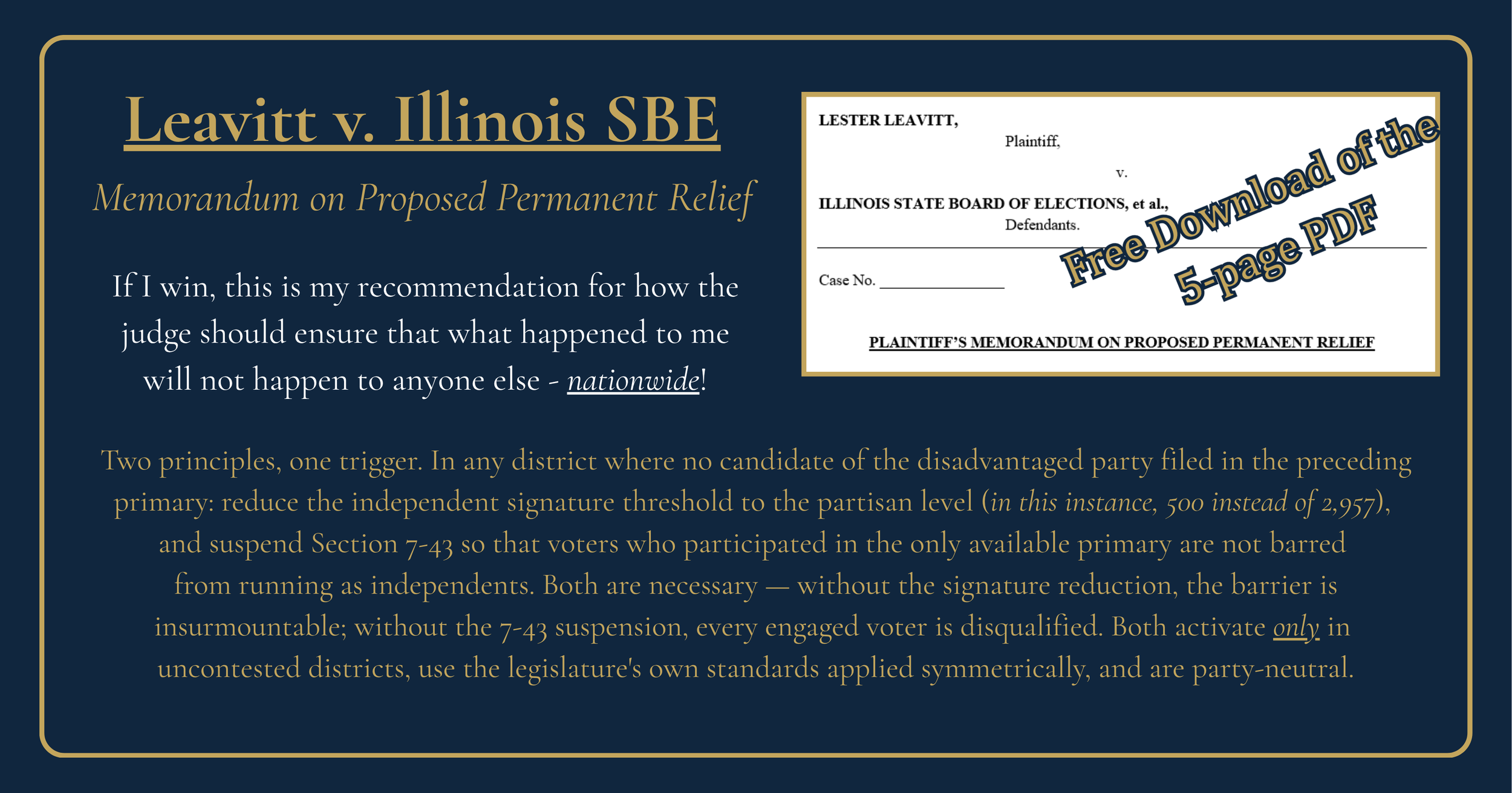 Image 1 of 1