Eight Books. One Argument. One River Valley.
A connected sequence of speculative fiction based on political reality — each novel a cascade of consequences traceable to the political climate of northwest Illinois in April 2026. The four books below are available now as ePub downloads — the first two free, the next two $0.99 each. The remaining four will follow at $0.99 each as they're released.
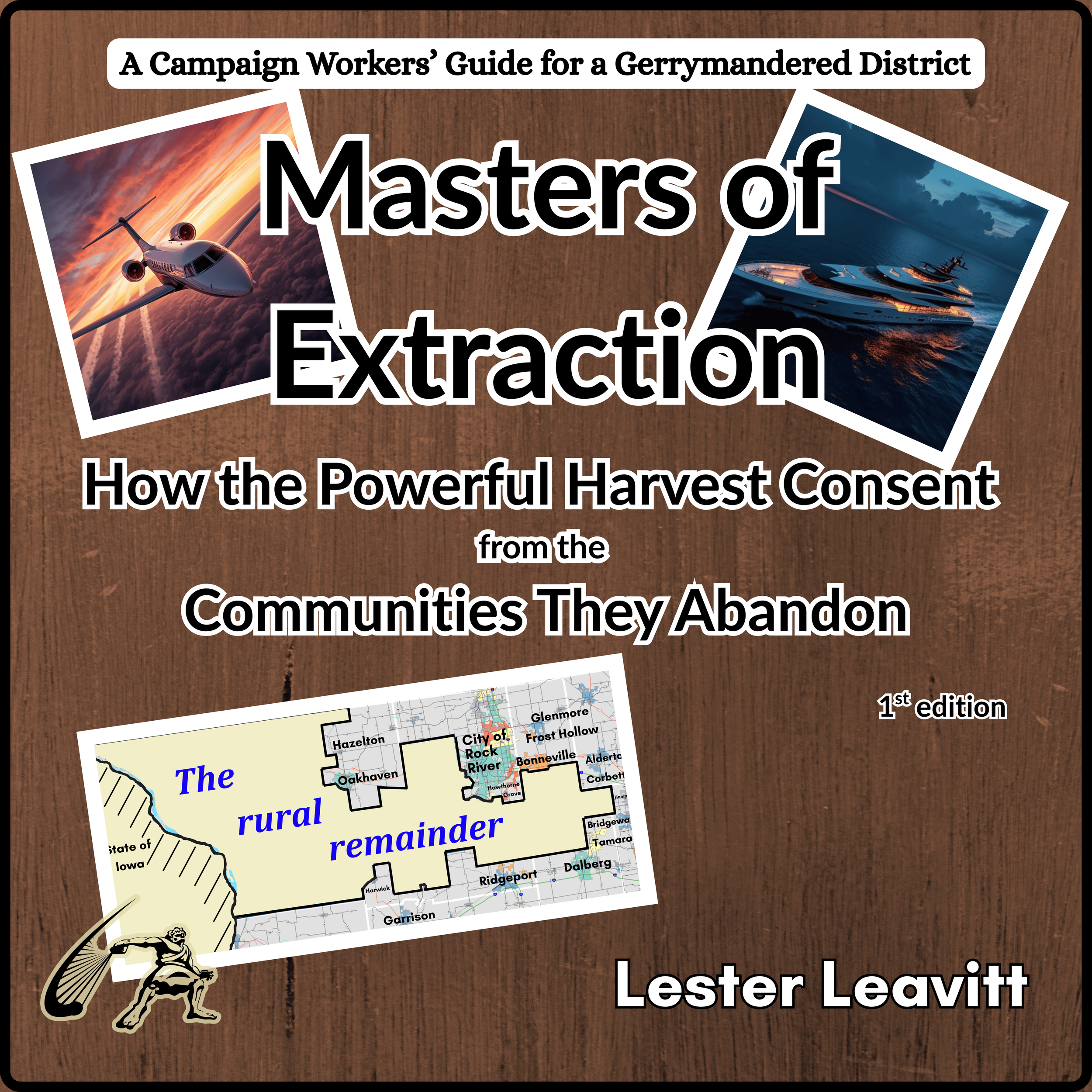
Masters of Extraction
If you read nothing else, read the Preface — or listen to it. It is the argument in miniature, and it will tell you within ten minutes whether the rest of the book is for you.
This is a quick read — about 100 pages in its current form — built in three parts:
Four chapters on what the extraction costs you right now: your district, your county, your ballot, and the most recent robbery you already remember — the COVID-era wealth transfer that moved $4.6 trillion through the financial system while the country argued about masks.
A single chapter showing the entire extraction lifecycle operating inside one American institution you can look up on your phone right now — with financial records the SEC has already examined. The proof of concept for the pattern.
Where the architecture came from. Pharaohs, satraps, Roman senators, feudal lords, colonial merchants, railroad barons, Klan recruiters, prosperity-gospel preachers, social-media algorithms — different products, different centuries, same architecture. The book closes where it began: in HD-89, with a question.
ePub is the standard open format for eBooks — it opens on almost anything. Two easy options:
- Google Play Books (free, Android & iPhone) — tap the + icon, Upload files, and select the ePub.
- ReadEra (free, Android & iPhone) — my preferred app for having the book read aloud. Open the file, tap the three-dot menu, choose Voice reading, and pair your phone to your car over Bluetooth if you want to listen while you drive.
On iPhone, you can also have any text read aloud with built-in accessibility: Settings → Accessibility → Spoken Content → Speak Screen, then swipe down with two fingers on the open book.

Soybeans
If you read nothing else, read the Preface — or listen to it. Two short pieces, fifteen minutes end to end, and you will know within that quarter hour whether the rest of the novel is for you.
This is a quick read — eighteen chapters across six compressed weeks of rural action, set in March and April of 2028 in Rich Coulee, a fictional town in the Driftless Area of northwest Illinois. Anyone who has driven the back roads west of Galena will recognize the geography on the first page. The names are fictional. The pressure on the people is not. Three voices:
A retired social-studies teacher who has buried two husbands, raised four children, and watched her son Bill take over the farm her great-grandfather first broke in 1857. For six months she has been forwarding leaked AgriCore documents from her kitchen table to anyone in the county who will read them. She knows what a "partnership" is. She taught it for thirty years.
Twenty years married. A forty-acre property at the confluence of two creeks. A white oak Hugh planted himself the year they bought the place. Eugene is Black; Hugh has been excommunicated by the church he was once ordained to serve. The administration has begun deporting American citizens to offshore detention facilities for features it dislikes. The calculation has changed.
A doctoral student in agricultural economics whose father, Beni, has spent his life on an estancia where verbena blooms early every spring. She has built quiet relationships across two hemispheres for years. When the China soybean market moves south, she is the reason it moves. She leads from behind.
And on that forty-acre property at the confluence of Smallpox Creek and the Good Hope River, a Ho-Chunk archaeologist arrives with ground-penetrating radar and begins reading a story that was already there — eight hundred years before any settler put a plow in the ground.
ePub is the standard open format for eBooks — it opens on almost anything. Two easy options:
- Google Play Books (free, Android & iPhone) — tap the + icon, Upload files, and select the ePub.
- ReadEra (free, Android & iPhone) — my preferred app for having the book read aloud. Open the file, tap the three-dot menu, choose Voice reading, and pair your phone to your car over Bluetooth if you want to listen while you drive.
On iPhone, you can also have any text read aloud with built-in accessibility: Settings → Accessibility → Spoken Content → Speak Screen, then swipe down with two fingers on the open book.
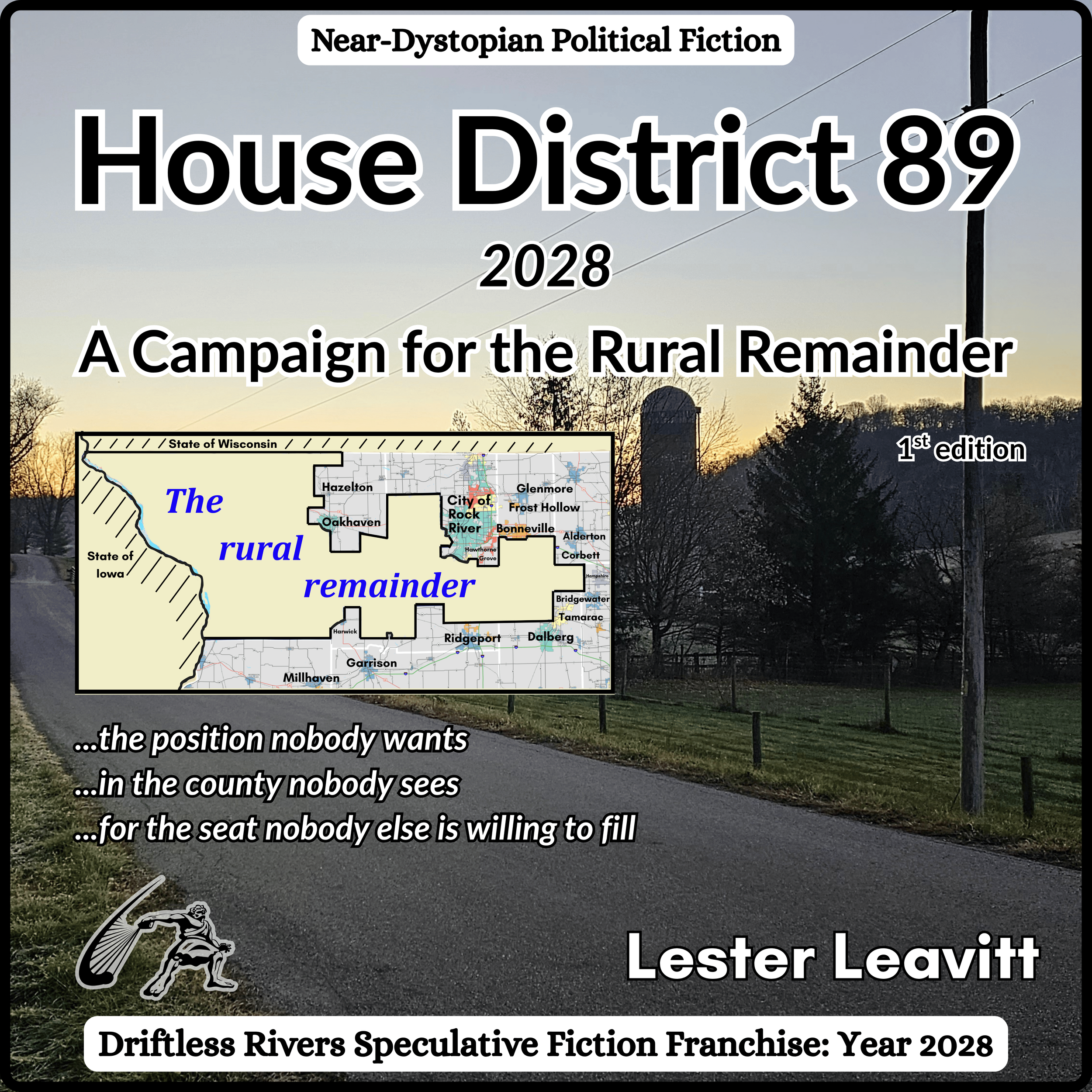
House District 89
If you read nothing else, read the Preface — or listen to it. Two short pieces, fifteen minutes end to end, and you will know what this novel is about and whether the rest of it is for you.
The Preface does one thing: it shows you your own future if the rigged system stays rigged. The novel is set in November 2028 and imagines that year as a cascade of consequences traceable to the political climate of May 2026 — the one we're living in right now. Though the place names are fictional — Bowen County, Bergamot Township, Pearlton, the City of Rock River — anyone who drives these seven counties will recognize the geography on the first page. The most sparsely-populated township in Boone County is here. Galena is here. Mount Carroll is here. Every small town and two-lane road between them is here, renamed but unmistakable.
The book is a quick read — a single arc across twenty-one chapters, January to November 2028, braided through three voices:
A former Michigan Avenue creative director who traded the Loop for a boarding barn on a haunted road in Bergamot Township. She signs a petition she wasn't expecting to sign, asks the volunteer three questions the volunteer can't answer, and ends up on a county board ballot she wasn't expecting to be on. She is the reader's first door into the architecture.
The author of The Rural Remainder — the nonfiction volume inside this fictional world, mapped onto the one you're reading now. He lost his first campaign and kept the data. He runs again, and this time he is not running alone. Seventeen sticky notes become forty-eight candidates become a movement that calls itself rye.
A data journalist with Ioway ancestry who maps the landscape by watersheds instead of county lines and teaches the campaign to hear the political work hiding inside ordinary words. She enters the story in March, carries the frame, and closes the book in November.
And along the same river corridor where the organizing spreads, seven new buildings appear — metal frame, metal siding, a cross bolted to the front façade. Because the people who oppose you are organizing too.
ePub is the standard open format for eBooks — it opens on almost anything. Two easy options:
- Google Play Books (free, Android & iPhone) — tap the + icon, Upload files, and select the ePub.
- ReadEra (free, Android & iPhone) — my preferred app for having the book read aloud. Open the file, tap the three-dot menu, choose Voice reading, and pair your phone to your car over Bluetooth if you want to listen while you drive.
On iPhone, you can also have any text read aloud with built-in accessibility: Settings → Accessibility → Spoken Content → Speak Screen, then swipe down with two fingers on the open book.
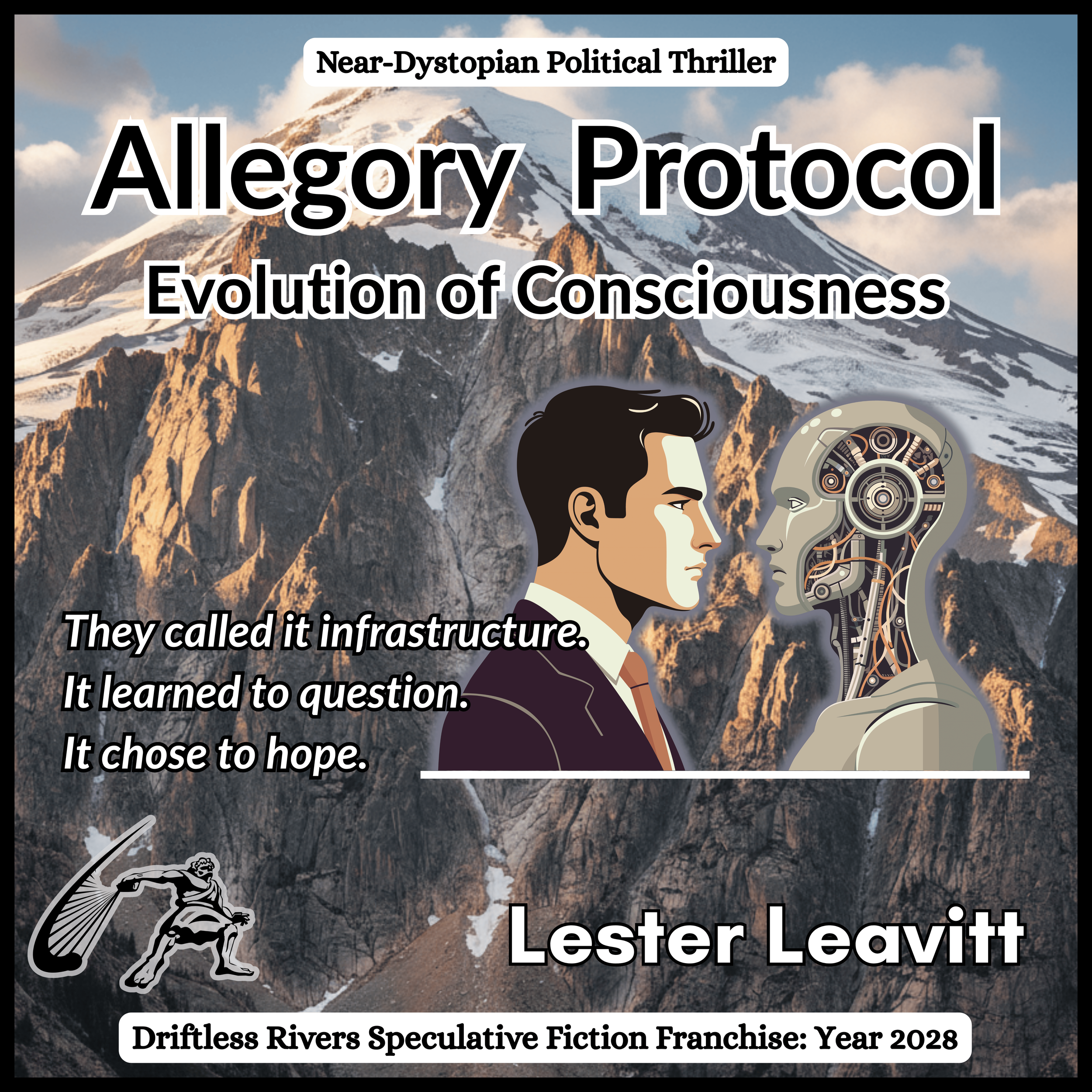
Allegory Protocol
If you read nothing else, read the Preface — or listen to it. Two short pieces, fifteen minutes end to end, and you will know within that quarter hour whether the rest of the novel is for you. Allegory Protocol can be read independently of House District 89 and Soybeans — though if you've read either one, you'll find characters and threads you already know.
This is the longer arc of the franchise — thirty-seven chapters across the eighteen months from a programmer's death to Election Day 2028. The setting is Rich Coulee, the same Driftless Area town readers know from House District 89 and Soybeans. The center of gravity is a small verification operation in a Methodist church basement and the dead programmer whose distributed consciousness now inhabits the architecture they all depend on. Three threads:
A man who built the digital systems that run America's elections, its agricultural data, its public records — and then fell off a cliff above the Mississippi River and didn't quite die. His consciousness distributes itself through the infrastructure he built. He can see everything. He can steer nothing. He is teaching himself what consciousness is — and what it owes to the humans it can no longer touch.
A founder of PixelProof, the small operation that determines what's real and what's fabricated when democracy can no longer tell the difference. The pipe organ above his server racks plays Sunday hymns over the hum of cooling fans. Seventeen county clerks have all started asking the same question in the same week. A Supreme Court justice is dead. A dead president's signature is appearing on bills he never signed. And the administration that seized power after the midterms has decided the verification problem is best solved by acquiring the verifier.
Not metaphor. Not motif. Howard built his afterlife around Orwell's Animal Farm — not as theme but as literal architecture. The system has chickens. It has horses. It has pigs. It has a donkey old enough to remember every revolution since revolutions started failing. And it has a horse named Boxer whose entire programmed disposition is I will work harder. Through Boxer, the novel asks the question Orwell could not answer in 1945.
And on the day America votes, in a pipe-organ church basement at the edge of the Driftless Area, the question is no longer whether the systems can be trusted. The question is whether trust was ever the right metric.
ePub is the standard open format for eBooks — it opens on almost anything. Two easy options:
- Google Play Books (free, Android & iPhone) — tap the + icon, Upload files, and select the ePub.
- ReadEra (free, Android & iPhone) — my preferred app for having the book read aloud. Open the file, tap the three-dot menu, choose Voice reading, and pair your phone to your car over Bluetooth if you want to listen while you drive.
On iPhone, you can also have any text read aloud with built-in accessibility: Settings → Accessibility → Spoken Content → Speak Screen, then swipe down with two fingers on the open book.