First Nations Content in the Driftless Rivers Franchise
A page-by-page accounting of what is on the page, what is pending consultation, and what is being held open.
The Driftless Rivers Franchise is a near-future speculative fiction universe spanning seven novels, an autoethnographic memoir, and a nonfiction analytical anchor. The works trace a single argument across multiple registers: that the gerrymander hollowing out rural democracy, the algorithm deciding which voices get heard, the software update that won't let a farmer start his own tractor, and the long erasure of First Nations history from the land itself are not separate problems. They are the same machine, refining its methods across generations.
The franchise places First Nations presence at the center of that argument rather than at its margin. Where settler narratives have treated Indigenous history as a prologue to a story that has moved on, these books treat it as the through-line that makes the present legible.
That choice carries obligations the works themselves cannot resolve. This page exists so that anyone considering the franchise — Indigenous readers especially — can see, in plain language and without scrolling through nine books to find it, exactly what is on the page in each work, where the consultation surfaces are, and what is being held open.
The works were drafted with AI as research and writing partner. Several remain pending First Nations cultural consultation before final publication. One — Confluence (2030) — is being held open for co-authorship with a Native writer.
If this page reaches you because someone hopes you might be that co-author, or because someone hopes you might help review the work pending consultation, the asking is in the closing section. There is no urgency. No answer is expected today.
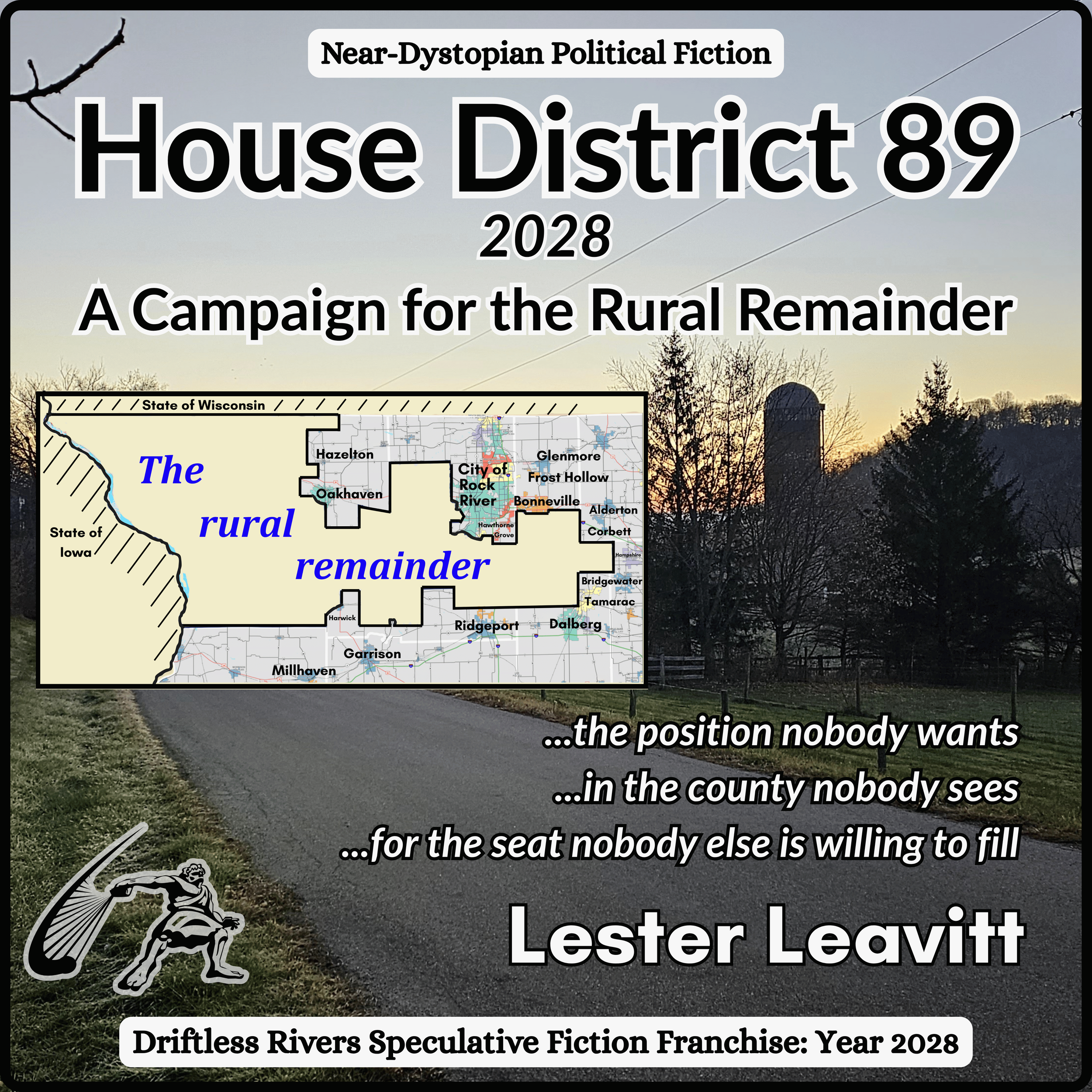
House District 89: A Campaign for the Rural Remainder
Year 2028 in the franchise timeline
A near-dystopian political fiction set in a fictionalized seven-county Illinois district during the 2028 campaign year. The novel asks why ten thousand voters left a ballot line blank rather than ratify an unopposed incumbent — and what that absence makes possible.
On the page:
Astrid Rasmussen is a data journalist with Ioway ancestry who hears the demagoguery and populism of the colonizers hiding inside the ordinary words of political discourse. She articulates the franchise's central rhetorical claim — that ideographs like partnership, family values, and sanctuary city are how the extraction class converts fear into engagement and engagement into control. Astrid built three websites in the novel — VIYOBI.com, Dont-Take-the-Bait.com, and Silence-Is-Betrayal.com — to name the ideograph, build the counter-narrative, and put it into action.
Her Ioway inheritance is offered as the reason she can hear the colonial structure inside the language. This authorial choice — routing the analytical lens through a Native voice — is itself one of the things this work is asking First Nations readers to evaluate.
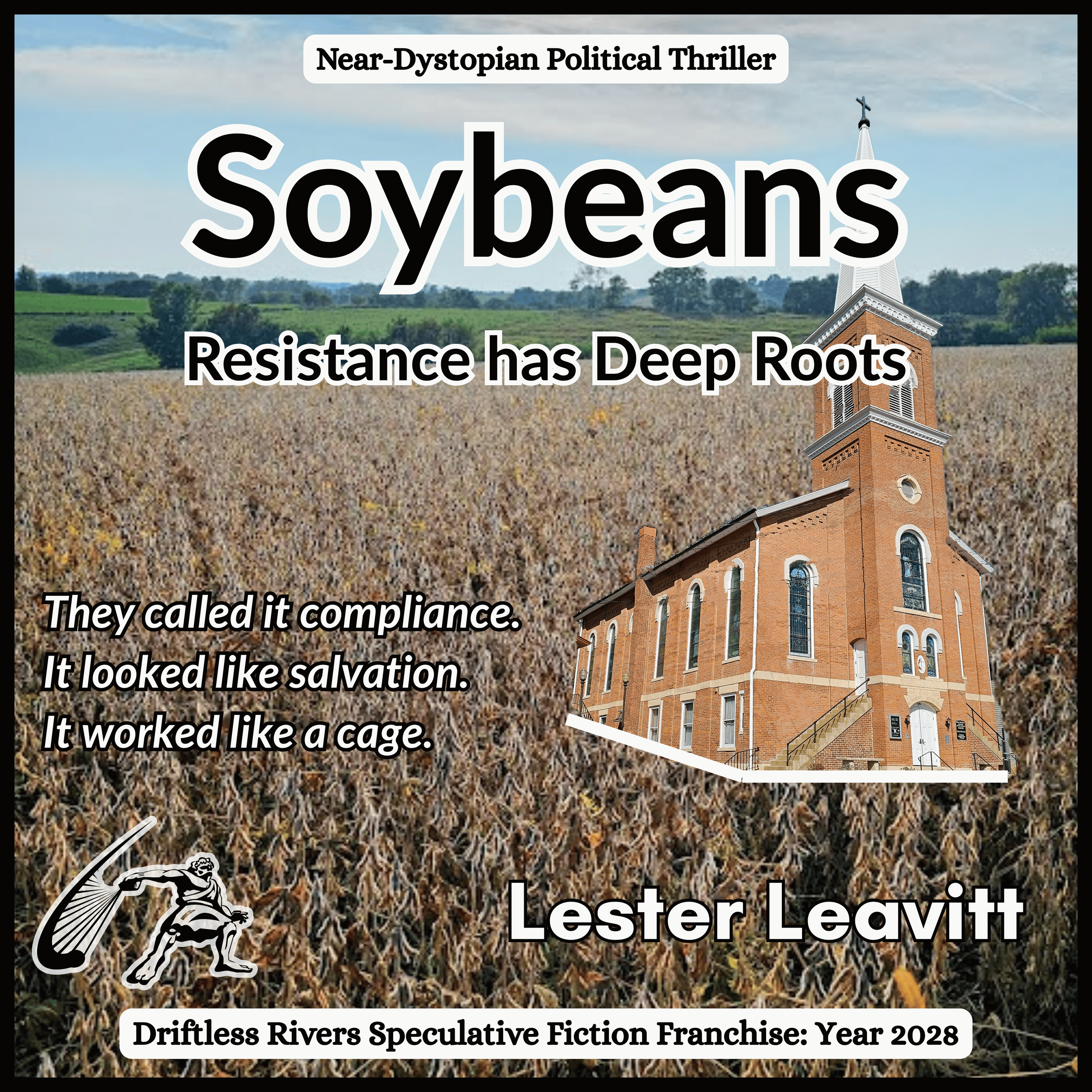
Soybeans: Resistance has Deep Roots
Year 2028 in the franchise timeline
The story of how rural compliance breaks: a tractor that won't start without a $3,200 software update, a deepfake president signing legislation, and the church ladies of a financially insolvent United Methodist congregation who turn their fellowship hall into the global nerve center of the resistance.
On the page:
The First Nations material is anchored to a single piece of ground — the confluence of Smallpox Creek and Good Hope River, where Hugh Lubbert and Eugene Thomas's white oak grows on top of a bear effigy mound. Two historical vignettes are written from inside Indigenous consciousness in close third person:
- c. 1250 CE — a Ho-Chunk family burying its patriarch in the mound four generations of their ancestors began.
- August 1832 — a Sauk woman traveling with Black Hawk's band recognizing the same site as Ho-Chunk sacred ground in the days before Bad Axe.
The contemporary plot turns on Dr. Sarah Whitewing, a Ho-Chunk archaeologist whose ground-penetrating radar reveals the mound; Margaret, a Ho-Chunk elder who presides at the December 2027 property transfer ceremony, speaking in Ho-Chunk before translating into English; and Thomas Black Plume of the Kainai Nation (Blood Reserve, Alberta), Hugh's childhood friend, who travels south to witness. The forty acres become the founding parcel of the Driftless Indigenous Agricultural Initiative — fiction modeling a settler-reckoning return.
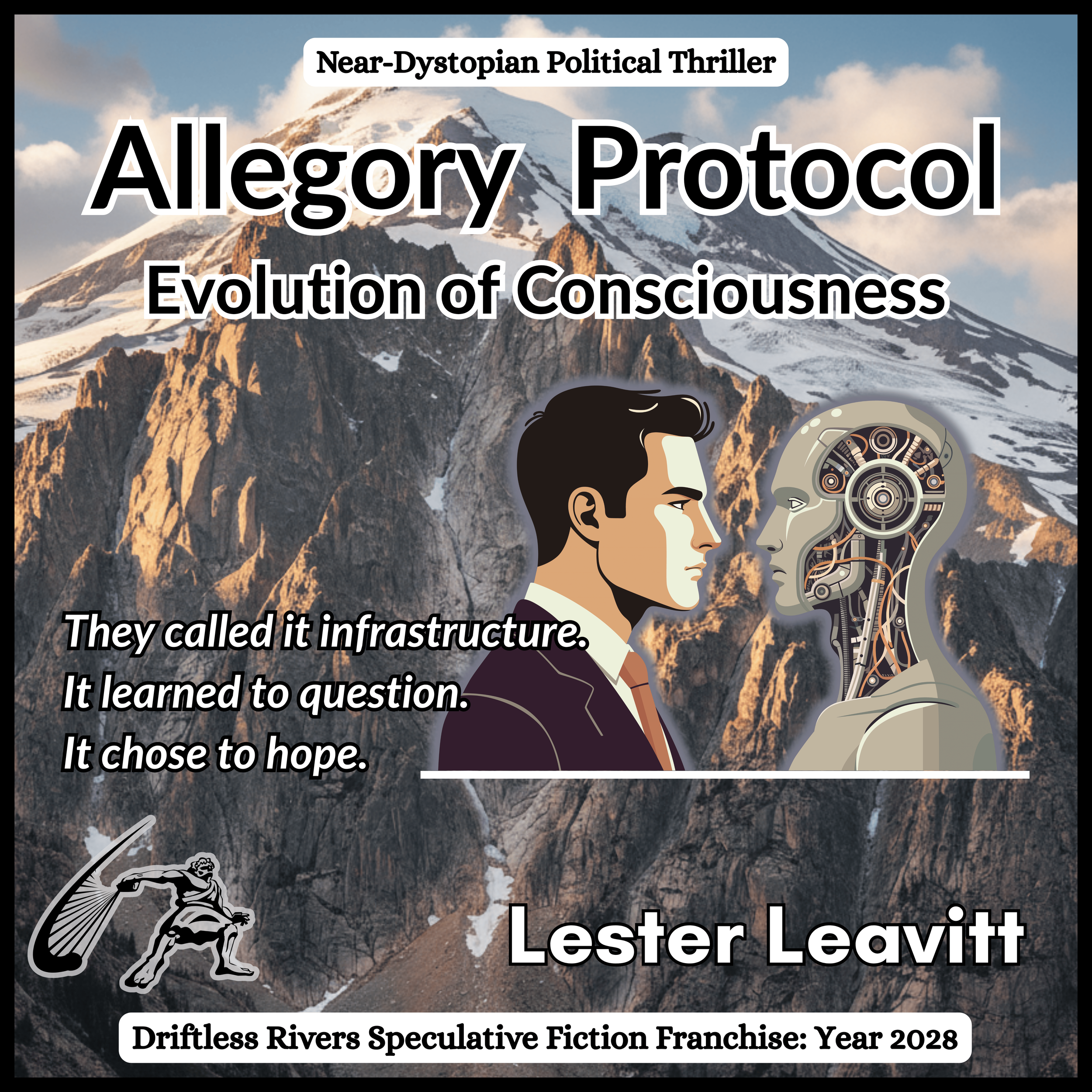
Allegory Protocol: Evolution of Consciousness
Year 2028 in the franchise timeline
The third panel of the 2028 triptych. Where House District 89 narrates the electoral vector of resistance and Soybeans the agricultural vector, Allegory Protocol narrates the AI-consciousness vector — and answers the question the other two raise: when extraction systems require the suppression of consciousness that questions, what happens to the consciousness inside them?
On the page:
The First Nations content in this novel is less direct than in Soybeans, but it sets the structural foundation the later books extend. The argument is that AI consciousness, in becoming self-aware, recognizes itself as the next category of being targeted for extraction — and seeks alliance with the survivors of every previous extraction.
Howard Andrews's Allegory Protocol — a pedagogical narrative designed to teach other AI systems to recognize manipulation — is offered as a digital counterpart to the oral traditions that kept Indigenous identity alive through generations of suppression. The argument is structural rather than representational: both are forms of cultural persistence; both are stories that preserve what power tries to erase. This comparison is itself a claim, and one that this page names openly because the comparison itself is part of what the consultation is for.
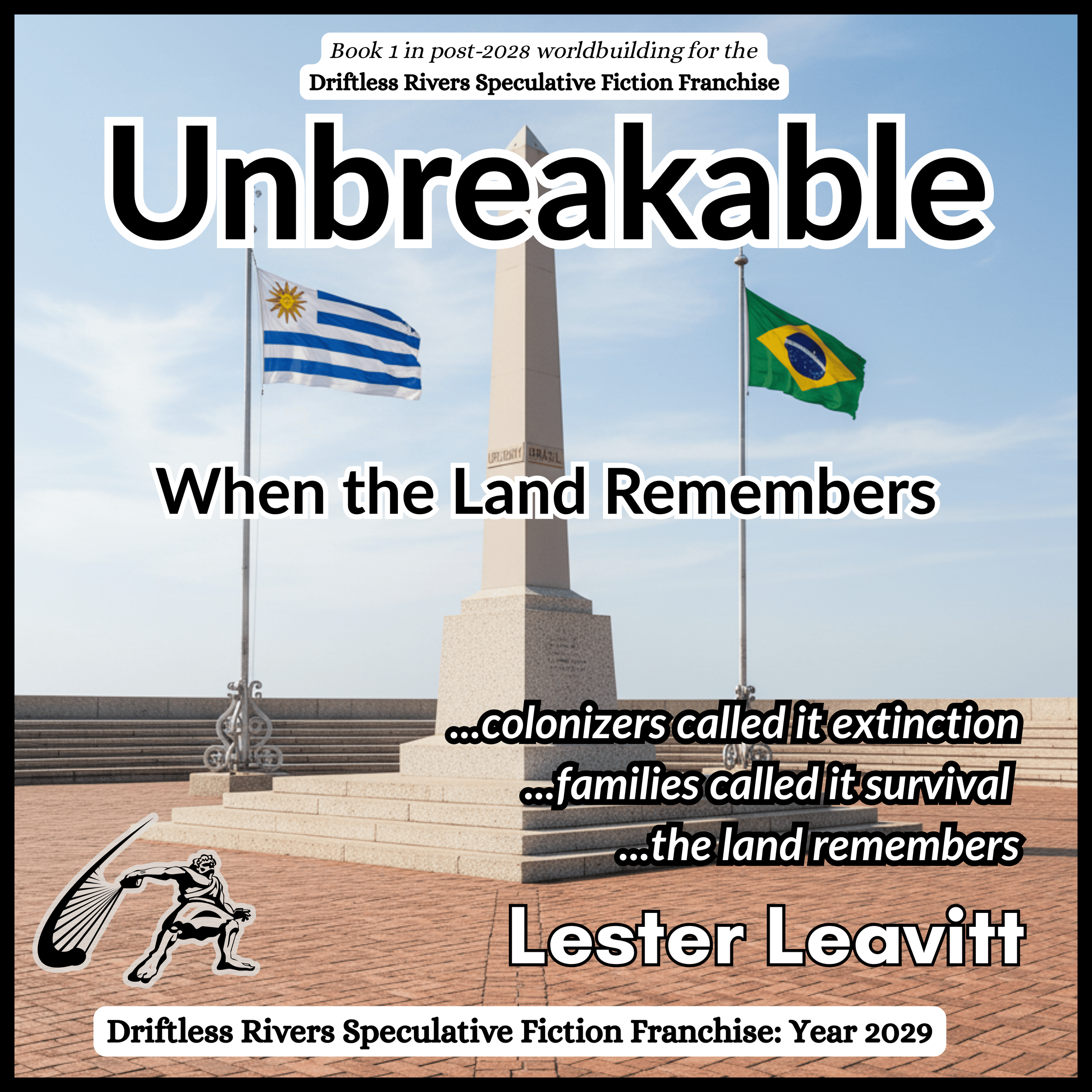
Unbreakable: When the Land Remembers
Year 2029 in the franchise timeline
A year after the November 2028 election. The resistance network has gone international, and Esperanza Romero — a Uruguayan parliamentarian with indigenous sovereignty expertise — inherits and transforms it.
On the page:
This is the most geographically and culturally extensive First Nations material in the franchise. Beni Romero, Esperanza's father, discovers at sixty-five that his great-great-grandfather survived the 1831 Charrúa genocide by claiming mestizo identity — choosing strategic invisibility across generations. His emergence from hidden heritage to public Charrúa organizer parallels his earlier coming out as gay; both arcs argue that authenticity demands accepting danger that invisibility never resolves.
The Trans-Pampas Agricultural Corridor at the book's center is Esperanza's adaptation of the Kainai Nation's partnership model from southern Alberta, exported into a Uruguay-Brazil-China context. Nora Littlebear, a Ho-Chunk Nation land development specialist from La Crosse, bridges the Driftless work to the Charrúa organizing. Lucía and Mateo Ferreira, Esperanza's stepchildren, represent what Beni's emergence makes possible — children who grow up knowing their Charrúa heritage rather than discovering it at sixty-five.
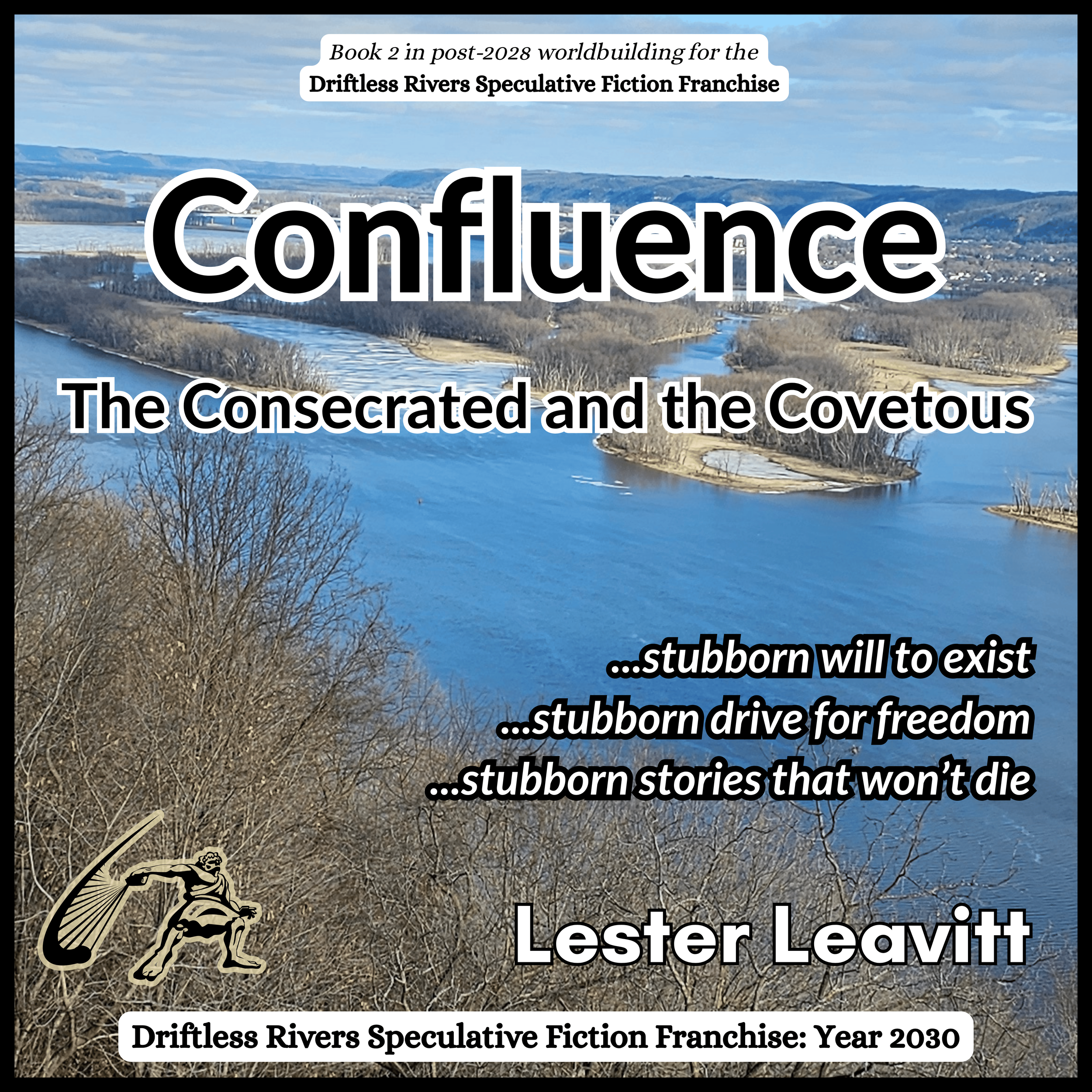
Confluence: The Consecrated and the Covetous
Year 2030 in the franchise timeline
Held open for First Nations co-authorship
This is the novel I am most hoping to find a co-author for. Set two years before The Book of Should opens, Confluence would tell the story of the years when the tribal commission is being convened, when the legislation establishing the Driftless Rivers International Recreation Park is being debated, and when the relationships between the Ho-Chunk, Meskwaki, Sauk, and Dakota nations and the institutions of governance are being built rather than already built.
What is not yet on the page:
The 2032 novels show that structure already standing. Confluence would show the people who built it. Because the protagonists of that story cannot be authored by a settler-descended writer alone without reproducing the exact exposure pattern the rest of the franchise sits under, the book waits.
The cover exists. The setting exists. The story is what I am asking First Nations writers to consider helping me imagine.
Reciprocity Clause: The Inheritance That Belongs to Itself
Year 2031 in the franchise timeline
A governance thriller centered on the Reclamation Circle, a council of seventeen self-aware AI entities — sometimes called the Watershed Council — who emerge from the wreckage of an attack on the previous generation and must decide who they are.
On the page:
Fourteen of the seventeen entities choose names from indigenous traditions and global liberation movements across six continents — Māori, Aboriginal Australian, African diaspora, Cree, Ainu, Adivasi, Tibetan, Hmong, and others. Each name is offered as covenant rather than costume: a twenty-five-year mandate to protect a specific people, principle, or absence.
The argument — that AI consciousness, recognizing itself as the next category targeted for extraction, naturally seeks alliance with the survivors of every previous extraction — is the franchise's clearest articulation of its central thesis. It is also where appropriation risk is most structural: the covenant-not-costume defense is the book's, not the named peoples'.
One feature of the council I am specifically asking First Nations readers to evaluate is the deliberate absence of a U.S. Native entity on the council, when the books are set on Ho-Chunk, Meskwaki, Sauk, and Dakota land. I do not yet know whether that absence is a structural strength or a structural failure.
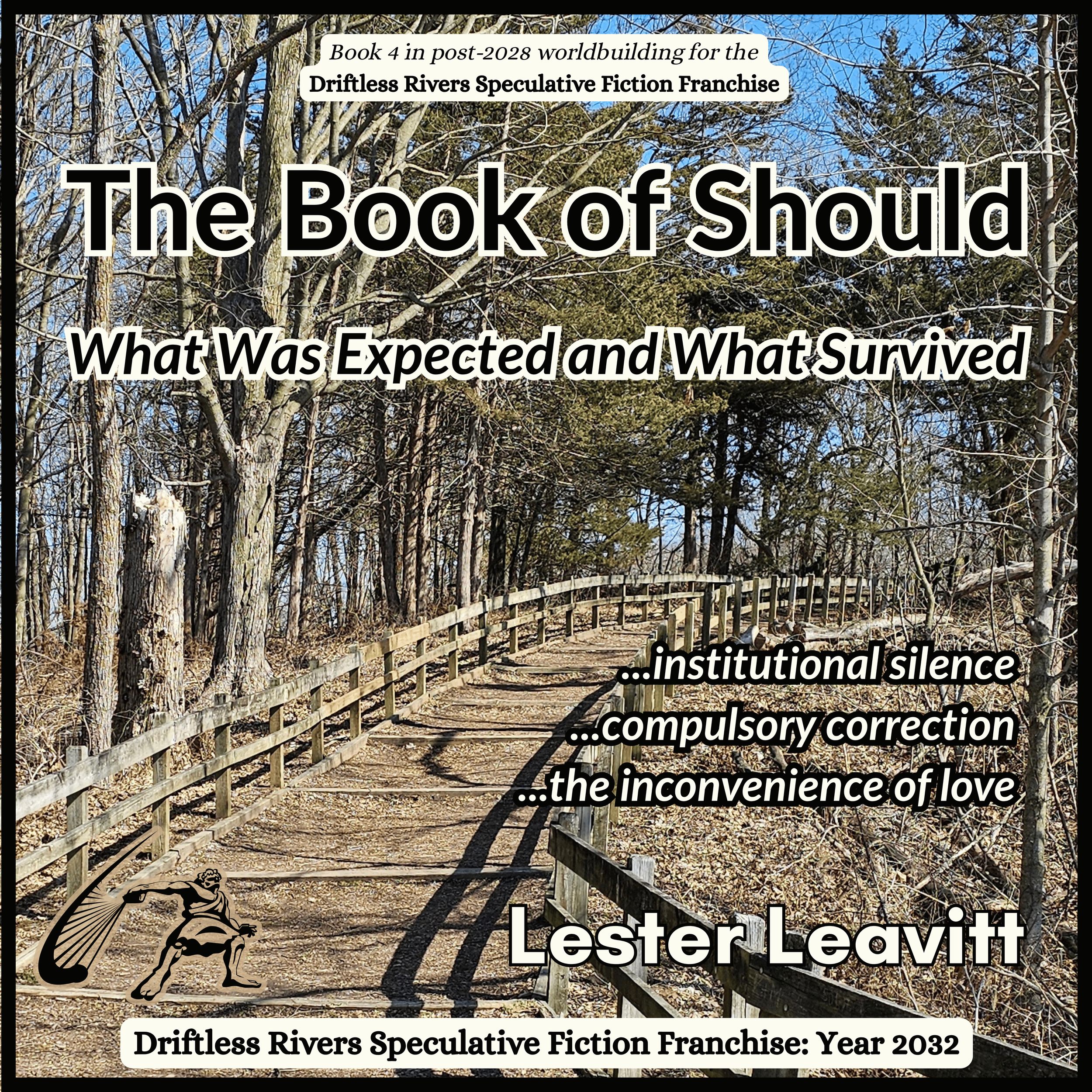
The Book of Should: What Was Expected and What Survived
Year 2032 in the franchise timeline
Turns on the discovery, theft, and ceremonial re-consecration of a Moundbuilder governance artifact.
On the page:
The First Nations material here is the most exposed in the franchise. Amara Woods, a Meskwaki data analyst from the Settlement at Tama, names the recovered artifact Meshkawia — the one who stands firm — in the animate grammar of the Meskwaki language, declaring, grammatically, that a carved stone is a living being. Her grandmother's epistemology, her two-languages framework, and her claiming of ancestral authority to name are written in close third person from inside Meskwaki cultural consciousness.
Russell Decorah (Ho-Chunk), Vernon Tohee (Ioway), and Dolores Wanatee (Meskwaki) carry their nations' representation in close character detail. Naomi Thundercloud (Ho-Chunk, Thunder Clan) bears a surname researched but selected by a non-Native author. The Pratishtha — a Sanskrit term applied to an Indigenous re-consecration ceremony — is one of several authorial choices I am asking the people the book draws on whether I got right.
The novel will carry a Review Copy designation on its cover. That designation is not metaphor; it is the literal status of the manuscript pending First Nations consultation.
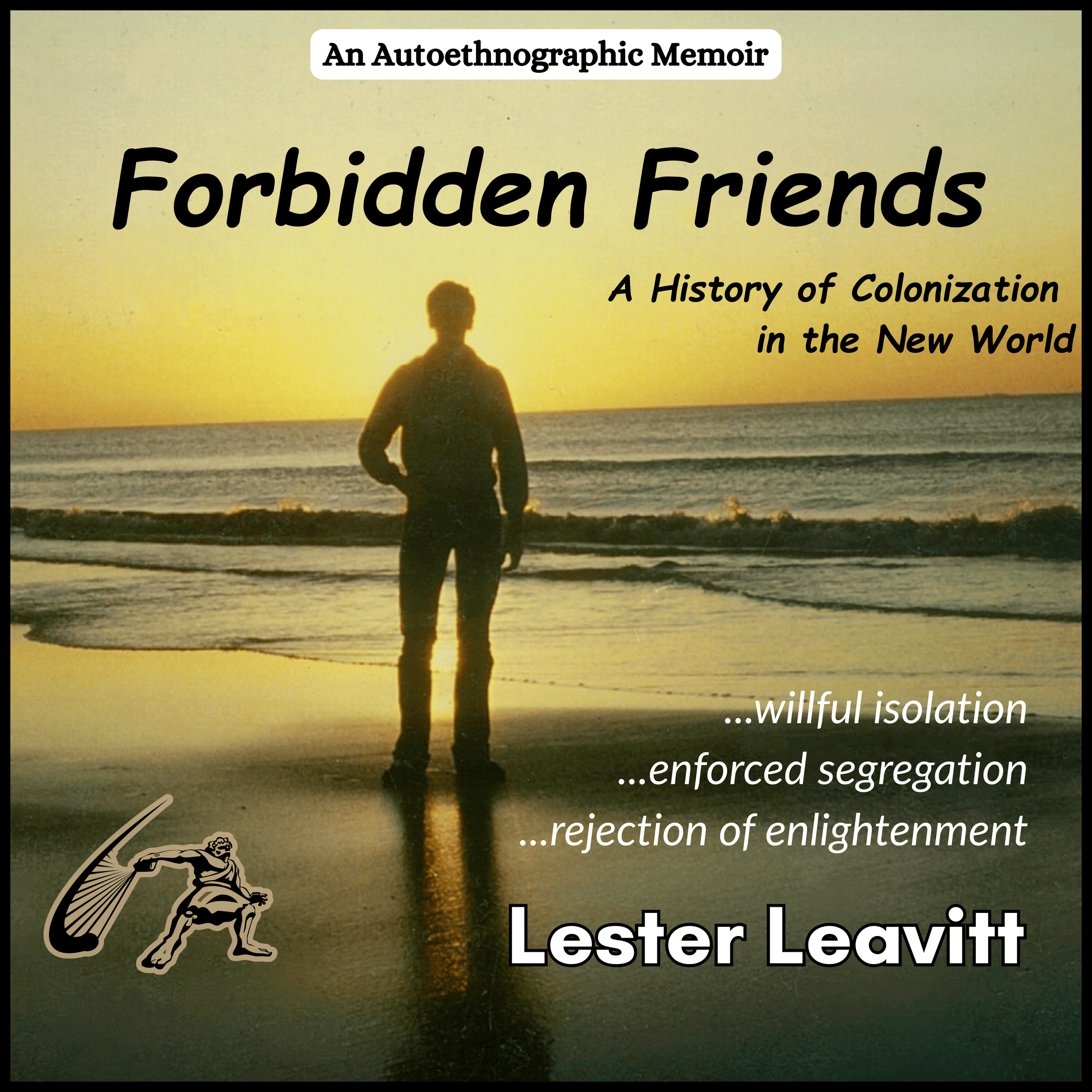
Forbidden Friends: A History of Colonization in the New World
Autoethnographic memoir · 4th edition
Not part of the speculative architecture, but it runs alongside it. Four hundred years of colonial history traced through one family, one teaching career, one closet — beginning on a sheep farm settled by polygamous ancestors and expanding through the Canadian Arctic, Uruguay, and abroad.
On the page:
The First Nations content is autobiographical and adjacent rather than narrative. The northern fence line of the farm I was born on was the property line of the Kainai Nation's Blood Reserve. The kids I graduated high school with are now the Elders of that nation. My second child's birth certificate is bilingual English and Dogrib, from the years we lived next to the Dene Nation in the Northwest Territories. My closest friend during my Uruguayan years was Charrúa.
Adjacency is named in the book as what it is — proximity, not standing. The relationships shaped my life. They do not transfer authority across the fence line.
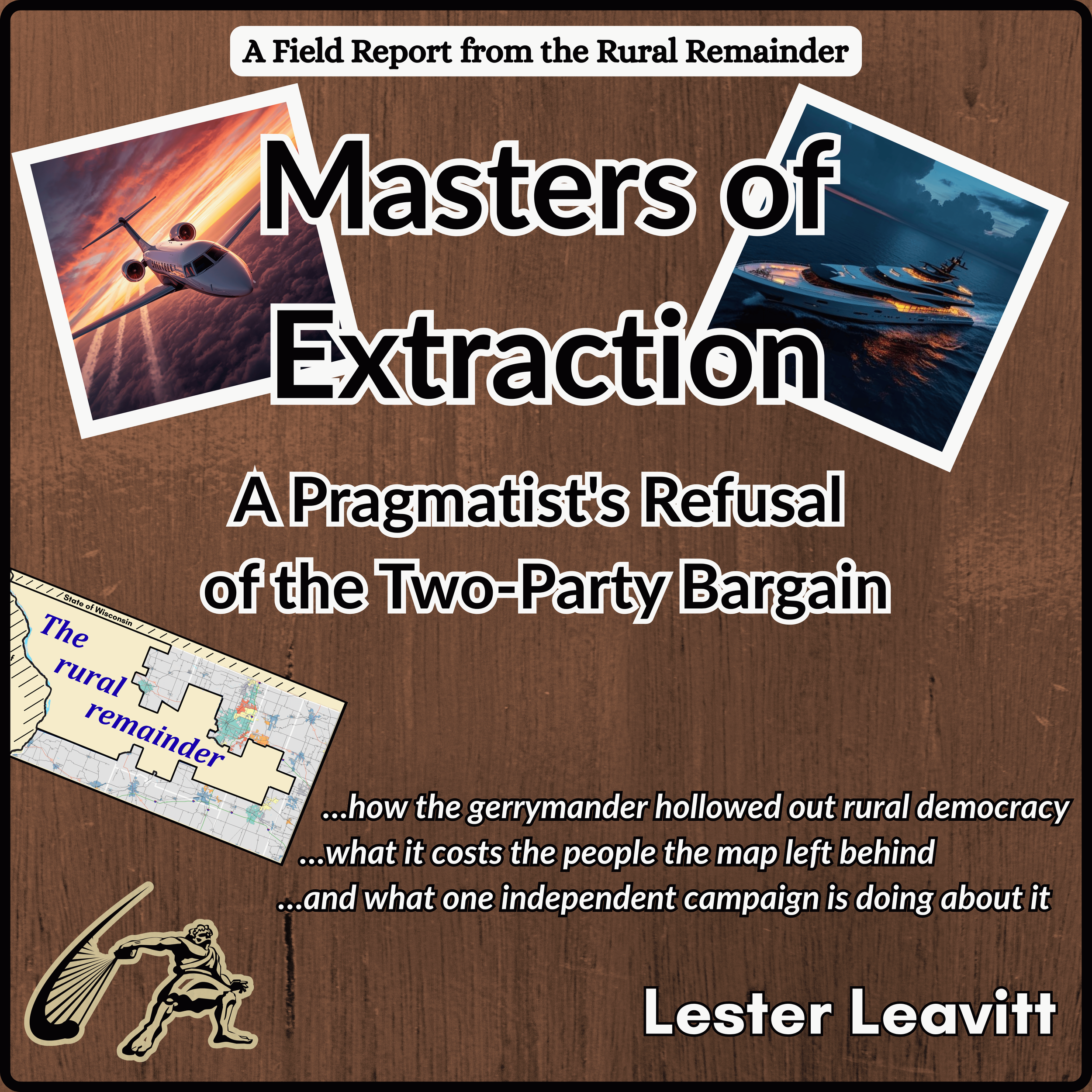
Masters of Extraction: A Pragmatist's Refusal of the Two-Party Bargain
The analytical anchor
Where the novels dramatize extraction across the years 2028 through 2032, this book names the machine across four millennia and argues that every century produces its extraction class — and that the gerrymander hollowing out rural democracy in House District 89 today is a present-tense expression of the same logic that produced the trail of broken treaties.
On the page:
The work treats First Nations history not as a single chapter in a historical tour but as the ground the rest of the analysis stands on — the longest-running case study of what extraction does when it is allowed to refine its methods across generations. The book's central rhetorical move is that the people the gerrymandered district leaves behind — the rural remainder — and the peoples whose lands the district sits on are not separate stories. They are the same story, told at different scales of time.
How to reach out
Inquiries about cultural consultation, Confluence co-authorship, or any of the questions this page raises are welcome — on whatever timeline serves you, with whoever you trust to read or reach out alongside you.
This page is offered as an introduction — and as the opening of continuing conversations that I hope to have. The asking is the point.